How Rikki Kher built KARDO into a global fashion brand, and brought it home
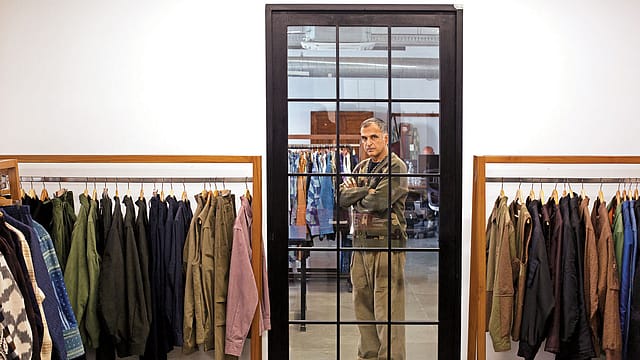
WHEN FASHION brand KARDO’s first store opened this November, people expected music. Rikki Kher, the brand’s founder and creative director, is known for his love of musicians and an expansive collection of vinyls—hundreds of records assembled over several years—as much as his crafts-forward menswear. The store, located in Delhi’s Lodhi Colony Market, marks a homecoming of sorts for the made-in-India brand which built much of its early success story in the international market, stocking at stores from the United States to Japan. Kher brought music to the opening day but not quite what guests thought they would hear. As the launch party peaked, a band-baaja orchestra entered the store, meandering through the crowds, playing popular songs on their trumpets and drums—loud, boisterous and in tune with the Kher’s brand ethos, to be “unapologetically Indian.
“We are not trying to be precious,” says Kher, settling into a couch at his studio in Noida days after the store’s launch. “We want to be as down-to-earth as possible, so that people are able to access Indian textiles crafts.” Unlike the neat, curated shelves of the store, where the brand’s Autumn/Winter 2025 (AW25) collection Prem Prasaar—dedicated to harmony in a troubled world—is on display for the season, the studio and factory spaces are piled with textiles, swatches and a sneak peek of what the brand will offer next. Over the years, many customers have turned up at the studio to get their fix from the brand, finding favourites through stacks of fabrics and garments. Now, Kher is often at his store interacting with customers and learning what they like. Making a sale still fills him with wonder. “I never want to lose this feeling,” he says.

Survival Instinct
22 May 2026 - Vol 04 | Issue 72
India navigates global economic turmoil with austerity and smart diplomacy
Becoming a designer was no childhood dream, but clothing has been part of Kher’s life for as long as he can remember. He grew up in London, living between the city and the suburbs and drawing style cues from his parents as well as his two older sisters (the younger of which is the artist Bharti Kher—one of her paintings is displayed at Kardo’s store along with a sculpture by her spouse, artist Subodh Gupta— rare sights in an Indian fashion retail space). “My mother was a seamstress. I didn't have one piece of bought clothing till I was 11—she made me everything. I once wanted denim jeans and she made me a pair,” he recalls. “My father was in the textile business, and very stylish—I always wanted to dress like him.” His oldest sister was another overarching influence, working at British brands like Katharine Hamnett and Jones London or hand-stitching garments for concerts—from her, he inherited a lifelong love for music and fashion.
Kher graduated from NYU Stern School of Business in the early ’90s and would have stayed in New York had his visa not run out. Coming back to London, he worked with his father on a textile business for a few years. But he discovered that selling clothes was more fun, when his former partner—who ran a clothing business in north London— left him to look after the store for a bit. By the time she returned, he had hung up his jacket and started selling to the customers who walked in. They eventually began working together.

At this point, Kardo was nowhere in the picture but India had become a dream destination for Kher. He had first visited the country as a three-year-old and remembered nothing. However his first trip in his 20s, to see Bharti who was building her artistic practice here, left him enthralled. “That trip was magic,” he says, trying to describe a dual pleasure of discovery and belonging. In the early 2000s, work brought him back to head sourcing and merchandising for the Spanish department store chain El Corte Ingles. Kher worked in the country until 2007 before taking a job in Kuwait, which turned out to be a disastrous experience; he returned to India some months later. A spate of bad luck unfolded over the following years, as he worked with textile businesses in different countries which often failed or left him with unpaid bills. If the experiences left him struggling financially, it also taught him resilience. Kardo was born in these years, when a friend noticed the clothes Kher would get tailored for himself and offered seed money to start a clothing business.
“I knew that I didn’t want to do fast fashion, and I didn’t want to sit in a factory,” he says. He had come across
Khadi textiles and beautiful fabrics on a trip to Jaipur and bought a handwoven ikat sari at a mela to cut into a shirt— these visits sparked an idea. “I thought that no one is doing textile crafts in menswear. So that’s what I am going to do,” he says. “I understood very clearly, early on, that my production had to be better than everybody else’s. My stitching had to be better. Everything had to be better because I also felt like an imposter.” The imposter syndrome emerged partly from the lack of having a formal design degree, but it was also shaped by the market. Crafts was not a popular idea in menswear yet, and the label initially struggled to find customers.
KHER DECIDED to focus on international buyers though that didn’t come easier. Homegrown brands have started finding a solid footing with international stockists only in recent years. Kher worked with agents, often “haemorrhaging cash” to pay their fees, receiving small orders and using them to fine-tune his supply chain and packaging. On a work trip to Las Vegas, he finally got the opportunity he long hoped for. In a meeting at a Dunkin Donut outlet, he signed on with Peregrine Showroom, which showcased menswear collections from around the world. Business began to grow as buyers took notice and Kher kept showing up even when nothing seemed to sell. “It can be soul-destroying when someone doesn’t resonate with what you do. But that’s part of the journey—it makes you stronger and it also makes you understand the market better,” he says. Today, the brand retails at Mr Porter in the UK, Beams in Japan, FWRD and Mohawk General Store in the US and Uncle Otis in Canada. In tandem, the clientele in India has swelled; many, like the electronic music duo Tech Panda and Kenzani, wear Kardo like uniform.
Kardo started with a single sewing machine and a master tailor, who remains with the brand till today when the brand has close to a 100 employees. The textiles are developed at different crafts clusters across India while design and production is done in Noida, with every garment stitched by one tailor start to finish. Jackets are made from a patchwork of textiles, plain shirts get a makeover with floral embroidery and trousers are tailored with a soft hand. Menswear dominates the product lineup, but there’s also a selection of womenswear—dresses, separates and outerwear with a similar soft, androgynous style. Following a low-environmental impact policy, Kardo also upcycles its production excesses, collaborating with Paiwand Studio run by designer Ashita Singhal, to reweave its leftover textiles and refashion them into new garments. “I am not making clothes for special events or one-off things, but for people to wear on a daily basis,” says Kher. “I have been always interested in utility clothing, vintage military—functional, but super comfortable. And then, we build a collection around an idea and textiles.”
Indian handlooms and crafts are Kardo’s parts of speech, abounding in its design vocabulary. The brand’s AW25 collection features silks with ari embroidery, Gond paintings by artist Mahesh Shyam, Tangaliya handwoven in Kutch and floral patchwork camo using deadstock cotton seersucker. The Spring/Summer 2025 (SS25) line featured Kala cotton, Suzani embroidery, Ikat and Khadi. Kher has worked with Naga loinloom and Rabari appliqué, crochet and Madras checks, block printing and bandhani. “When we work with artisans, we are investing in them as much as they are investing in us. We are not helping craftspeople survive—it’s a patronising, hierarchical, colonial point of view—they are equal to us,” says Kher, adding that Indian fashion, not just a few brands but the entire ecosystem, can make a mark in the global landscape only with a collaborative spirit among brands, artisans and all stakeholders. “It doesn’t mean that you don’t grow, it means that we grow together.”
Behind Kardo’s quiet success lies relentless hustling and building on relationships—with artisans, buyers, and customers around the world. India has always been behind the scenes, making the brand what it is today, and now seems more exciting than ever. Little wonder that even after scouting a “perfect location” in London, Kher decided that he would rather build the brand’s first flagship store at home, where he lives with his wife, jewellery designer Olivia Dar, and two daughters (he also has an older daughter with his former partner). “We are from Delhi, the brand is from Delhi—this is our identity,” he says. “And, I am betting on India. People are resonating with what we do now.”