Puneet Kaushik: Handmade Mystique
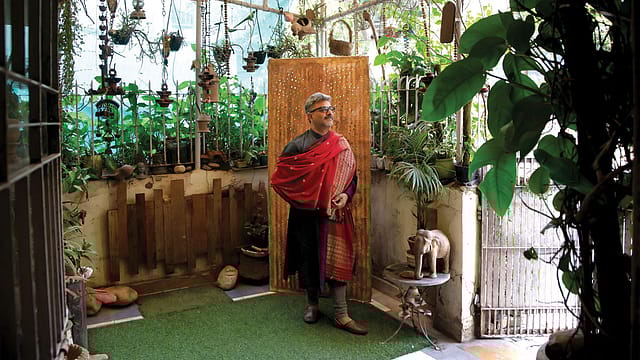
PUNEET KAUSHIK’S TRYST with art began with greeting cards, familiar to anyone who grew up in the pre-texting years when snail mail delivered good wishes on special occasions. “Growing up in Delhi, we were four kids and I was one of twins. During festivals, Diwali or Christmas and New Year, we would make greeting cards,” says the artist. “Drawing those cards is really what started me off.”
Decades later, Kaushik’s canvas and materials have expanded far beyond greeting cards yet their DIY creativity still lingers in his works. Take his installation at Inheritance of Light, Geographies of Loss, a multidisciplinary showcase hosted this January at Delhi’s Travancore Palace. Mapping the Silk Route on a series of textile panels, Kaushik worked with indigo dye and hand-block printing to create a cityscape awash in blue topped with swans perched on Tibetan clouds. In a forthcoming show, titled Unstitched: Saris – Their History and Future, to be displayed at the Asian Art Museum in San Francisco, Kaushik will present another work of craft-meets-art—a sari incorporating elements of sanjhi, a paper-cutting craft, depicting a landscape spanning Delhi, Mathura (where sanjhi is practised) and San Francisco. Later in the year, his works will be exhibited in New York while closer home, an AI project on history and mythology is turning his attention and creative instincts in a new direction.
Indian history, heritage crafts and textile traditions have become the cornerstone of Kaushik’s practice, developed in close engagement with crafts communities and master artisans around the country. It is a long way from the late Nineties when he began as a fine arts graduate from Jamia Milia Islamia heading to UC Berkeley. “I used to do very colourful works, and somebody described it as art from a developing country,” he recalls, laughing at the memory though the incident had been deeply hurtful. Kaushik decided to stay and work in the West, to “show that we were more than that”, but he was also certain that he would eventually return to India.

India's Action Hero
27 Mar 2026 - Vol 04 | Issue 64
Riding the Dhurandhar Wave

The journey from acrylics on canvas to the profusion of crafts which now populate Kaushik’s art emerged from a longstanding interest in handmade artistry and serendipitous meetings. To live in India was to be surrounded by crafts, but his perspective changed in the US where he saw small, handmade items being sold at $10-15. “In India, we were used to seeing crafts for cheaper prices,” he says. “But we also saw different medium and influences—be it a clay pot, a Banarasi sari or filigree gold jewellery and Kashmiri embroidery.” Meeting Laila Tyabji, founding member and chairperson of Dastkar, Kaushik expressed the desire to work with the organisation. Over the last two decades, he has undertaken several crafts projects with Dastkar, and serves on the organisation’s Board of Directors.
Kaushik’s passion is visible across his Delhi home. Exquisitely crafted Bidriware on tables and Tanjore paintings gleam on the walls; antique sculptures stand out on shelves and the couches are layered with vintage Phulkari and tie-dye textiles. The collections have grown as he has worked with artisans on various projects and initiatives. He also credits his wife, textile designer Rema Kumar, as an influence in his work; the two often travel together, visiting weaving communities and looms. “I have an antique collection of textiles, as well as folk and tribal art. A lot of friends call me a collector, but I describe myself as a hoarder,” he laughs.
Sprinkled among these objet d’arts are Kaushik’s own works of art and interventions which reveal themselves as one looks closer. A long canvas first catches the eye for its sunset hues, but go closer and the honeycomb pattern turns out to be delicately crocheted yarn. Durries are refreshing with abstract and colour-blocked geometrics while a series of red textiles panels get a 3D makeover with small bits of katran (leftover cloth scraps). “In India, one finds something beautiful every few kilometres—languages change, so do mediums and expressions of art. We see indigenous crafts and use of local materials,” says Kaushik. “There was never one medium that attracted me but the technique. My muse is craft, and how it is made.”
Kaushik’s works are rife with metaphors and material experiments, even at their most minimalist and abstract. Working with Tibetan beadwork in his early years, he experimented with the placement of beads and base materials to help sustain a declining handmade tradition. “It’s painstaking but the craft and technique survive,” he says. Tie-dyeing, zari, weaving, mesh, inlay and metal— nothing is out of his comfort zone. In 2025, at Jodhpur Arts Week, he presented an installation incorporating the work of 18 artisans that later travelled to Delhi for a showcase at Gallery Espace (which represents Kaushik). Drenched in red and gold, the installation explored narratives of femininity and tradition, juxtaposing the reverence for mother goddesses with the everyday violence against women. Sartorial emblems of womanhood—jewellery, wedding saris, ornamental details—became part of the medley. “As I explained the idea to artisans, they would make suggestions for the textiles and materials to use,” Kaushik adds. “They find ways to work and work and innovate.”
KAUSHIK’S ARTISTIC practice has a dual aim: to create art as well as impact the lives and livelihoods of artisans he closely engages with. He invests time and effort into learning the crafts he works with, seeing these as the means to win the trust of craftspeople and involve them in long-term partnerships. “Artisans have taught me a lot—they are experts but also humble. We may have art degrees but we can’t do what they do,” he says. Despite an increased appreciation for crafts, and their ubiquity in contemporary fashion and design industries, artisans continue to confront challenges—be it competition from cheaper products and factory-made replicas or keeping up with changing consumer preferences. Kaushik recalls a conversation with a Bidri artisan, during a Dastkar project, who said that he would never marry his three daughters to craftspeople. His eldest daughter was married to a porter, because that menial job was more lucrative than pursuing crafts. “It is important that artisans receive the respect they deserve. It is the means to sustaining them and helping them survive.”
As his engagement with crafts has deepened, Kaushik has also expanded into curatorial projects—of which the biggest and most exciting was the art collection in the new Parliament building. “I had never worked on that scale, and my learning was very different—I was being educated myself,” he says about the project. “It was important to get as many people and crafts and we brought textiles, folk and tribal arts from every state and union territory.”
More recently, he has been working with communities around the Kanha Tiger Reserve Area to refashion traditional handmade brooms from the region as home goods and to explore their use as decor for weddings and festivities. “We want to use only sustainable crafts and materials,” he says. “People spend a lot on weddings, so if we can involve craftspeople and artisans in making things for them, we will have achieved something.” If Kaushik’s art is his individual expression, his design interventions are aimed at empowering his crafts collaborators to expand their design practices for the contemporary market. “An artist has his own point of view, perspective and reaction to an issue. But design must have functionality—it should cater to people and their requirements,” he says.
At the heart of this conflation of art, material exploration, crafts and community—lies Kaushik’s vision for art that is as sustainable as it is beautiful. “We have an inherent sense of sustainability—others buy jewellery, we inherit it. We wear our parents’ clothes and preserve our family furniture,” he says. “My engagement is understated, built into my practice. The process integrates everything I believe in.”