Prize and Prose: Will a novelist dare to declare independence from the Booker?
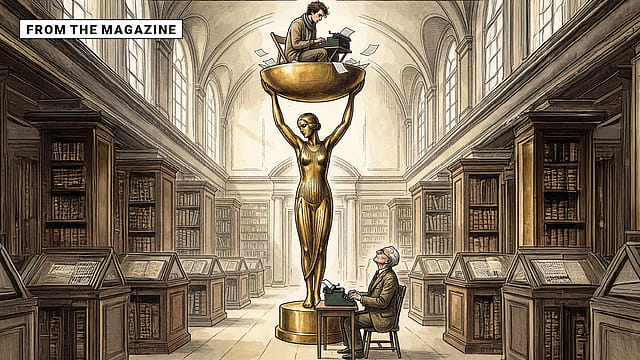
WE’LL ALL AGREE THAT THERE ARE two kinds of novelists in the Anglophone world today—the Booker-philic and the Booker-phobic. I might be accused of doing what novelists are not supposed to do—to generalise—but it was also a novelist who was forced to resort to the most sweeping generalisation of them all: “On or about December 1910 human nature changed” (Virginia Woolf in her 1924 essay ‘Mr. Bennett and Mrs. Brown’). I won’t be able to put as precise a date as that on when the Anglophone novelist changed. It couldn’t have been in 1969, when the publishers Tom Maschler and Graham C Greene, who came up with the idea for the prize, found a backer in Booker McConnell, a conglomerate with a significant long-term presence in Guyana. Could it have been 1976, when the BBC first televised the prize ceremony? For the Indian novelist writing in English, it might have been 1981, when Salman Rushdie’s Midnight’s Children won the prize. Might? No, must—for it provided inspiration and instruction to what would become a shorthand understanding of the Indian English novel for the next decade. By 1997—the fiftieth year of Indian independence, and The God of Small Things—it had been decided. Writing a novel in English wasn’t enough; finding a publisher wasn’t enough; one just had to win the Booker Prize. Arundhati Roy’s Ayemenem would make it possible for English language users in small towns to imagine that there was a novel inside and around them that could impress Pankaj Mishra and the Booker Prize judges. All of this is to state the obvious—the English language novelist became a satellite of the Booker Prize.
There is no instance in literary history of a single prize changing the character of a genre. I wonder whether the ancient Olympics forced the format and rules of sports to change. The Booker has forced the English language novel to gradually turn into a tissue of second guesses, and the novelist into a bookie. For the novelist has to hedge their bets on what the judges would like, the trending ticker tape. I’m trying to think of an analogy—fashion designers set trends with their designs of upcoming collections, retailers follow the trend. The Booker-philic novelist has to read the signs of the market, with the equivalent of telescope more than binoculars—they must predict human behaviour and emergencies at least five years in advance, and, in this, the stockbroker has a greater advantage over the poor novelist. Who knows when human suffering will be replaced by plant suffering or that by river suffering? But writers, who had fought against autocrats, dictators and governments, now placed their trust in what they understood as the imagination or a prescience peculiar to artists and surrendered their freedom without resistance. It seemed only a prize after all—except that it was a bit like being the school captain, a position that forces obedience even on the most rebellious. And hence the gradual surrender of the novelist’s fundamental right to freedom—the right to offend and criticise capitalism, communalism and country became the novelist’s only task, not to challenge the status quo of subject and form and the system itself.
My thoughts are not original—versions of them would have occurred to most readers of the English language novel in this century. I’ve heard variations of Booker-ennui from writers themselves: “Why are Booker novels unreadable?” One could attribute such a declaration to the narcissism of little differences except that it’s a common diagnosis amongst readers as well.
The immediate trigger for the coagulation of my thoughts is a Gwendoline Riley interview from March this year. I read it in May, right after finishing her novel First Love, propelled by a short-term desire to discover a little more about the writer. Her profile in the Observer began by erecting testimonials from writers who called her “bewilderingly gifted”, followed by the profile writer’s own bewilderment: “Twice ignored by Granta’s once-a-decade roll of best young British novelists, she has never been nominated for the Booker.” And then the B-word from Riley herself: “In a sunless meeting room at the Clerkenwell office of her new publisher, Picador, where she has followed her editor from Granta, Riley tells me none of her novels really strike her as ‘Booker books’, not that she means anything bad by that (‘Listen, I wouldn’t say no to fifty grand’).” It raked up a category that has subliminally lived in our heads for some time. The ‘Booker Book’.
WHAT IS A ‘Booker Book’? In trying to define its characteristics, I thought of going back a hundred years and a little more. What are the English language novels on an old-fashioned literature syllabus that might have won the Booker Prize? Two 19th-century novels came to my mind immediately, one of which is a favourite of mine: Middlemarch and Moby Dick. What about the earliest novels in the language? Robinson Crusoe? This Area Studies novel would certainly have made the shortlist. Pride and Prejudice? I couldn’t be sure. Oliver Twist? Oh yes. Mrs Dalloway, To the Lighthouse? No way. Orlando—it might have just managed to sneak into a longlist. A Passage to India? It might have won the prize. As might have Ulysses (there’s a tradition of the Booker book that finds critical supplication but not a common reader’s understanding and appreciation). A Portrait of a Lady? Maybe, as a kind of ur-global novel (so I’ve heard it being called, a category that feels a bit like the American passport, allowed entry into most countries, and what most other passports aspire to become), whose inter-continental travel theme would migrate to stories of migration, to keep pace with budget airlines and the labour market. Heart of Darkness? After postcolonialism? The horror, the horror.
The Booker Prize has become the shiny successor to FR Leavis’ The Great Tradition, the canon-forming book where the British literary critic anointed Jane Austen, George Eliot, Henry James, Joseph Conrad and, with some hesitation, DH Lawrence as true “great English novelists”. He’d ignored Joyce, Dickens, Fielding, Sterne, Defoe, the Brontes, and various others. Leavis’ expectations were transparent: the novels needed to be predicated on human values, moral hygiene and psychological truth. Techne didn’t matter. He was prescient—the Booker jury has only needed to adapt and update the criteria to suit their manifesto. ‘Morality’ is no longer an abstraction, it is easy to spot, usually carrying an -ism as a surname. It appears as ‘cause’—gender, race, caste, class, capital, war, environment and, of course, history, the angel of history.
A NOVELIST WHO provides mere pleasure is of no interest or value to the Booker Prize committee. They are the extras of the literary world now. Before the Booker test, though, there are the publishers—timid weathervanes, they nominate two books from their stable that are likely to get the U/B (Unrestricted Booker) acceptance from the committee. The English language novelist must use the novel as a pulpit—or panchayat—from which they could change the reader and the world. The Bible might have won the Booker Prize if only its publisher had nominated it. Even the Bhagavad Gita stood a chance at one time—the Booker Prize of the last two decades of the 20th century loved an overpopulated novel after all. The 21st century Booker Prize is an equivalent of the Nobel Peace Prize. It rewards the broken and battered, the marginalised and the neglected. The English language novelist has to champion at least one of the constituencies of the oppressed. In this it is an exact mirror to the Humanities academia—the Subaltern Studies historians, for instance, moved from taking up the cause of human citizens to taking theoretical care of the environment; novelists have had to do the same. Cli Fi—sounds like a cross between Wi-Fi and Kung Fu—novelists are now being routinely rewarded by the Booker establishment, the Anthropocene Novel is being canonised as the 21st century Great Tradition by the jury. The Booker Prize judges of our times are not Cambridge snobs like Leavis but a glossy democracy of celebrities—actors, chefs, politicians, broadcasters, the Pope (okay, I made the last one up)—who decide what bookstores will have on their windows from November to the spring of next year.
Not pleasure but guilt, not seeing but saving has become the DNA of the Booker Prize. These subjects are the new schoolmasters; the novelist has become a PhD student who must write a dissertation to satisfy their supervisor and only two other examiners to get a degree. The novelist has to scan and satisfy the QR code of the Booker Prize jury, keeping its changing constitution in mind. Sadly, subjects that need to be saved are reshuffled from time to time, depending on emergency and contingency. Like the changing animals that mark one Chinese year from the other, the Booker Prize jury moves through a roster of themes that they recognise as driving the human species to extinction. Reading the Booker book will change us and the destiny of our species. The poor novelist has to choose the subject of his novel with the same faith that the mutual fund investor puts his money in a fund based on its past performance, hoping that history will repeat itself. Sometimes it does—and the war novel returns, as if to supplement the news cycle. Sometimes it doesn’t—and the subject of the novel, once topical and urgent, is treated like a stale newspaper. There’s the other kind of novelist—they are like the Bhakti poet-saints who rebelled against the rituals of religious orthodoxy. Having rejected the religion of the Booker Prize, they, in turn, are rejected by its new age priestly elites for whom the Booker is like the Aadhar Card, a basic eligibility for the novelist’s right to exist. Booker-phobic, they hang like a wet coat—their publisher might drop them, like Gwendoline Riley’s did, any moment.
“Was he free? Was he happy? The question is absurd:
Had anything been wrong, we should certainly have heard.”
‘The Unknown Citizen’, WH Auden.