Personal Inheritance: Pen’s Pal
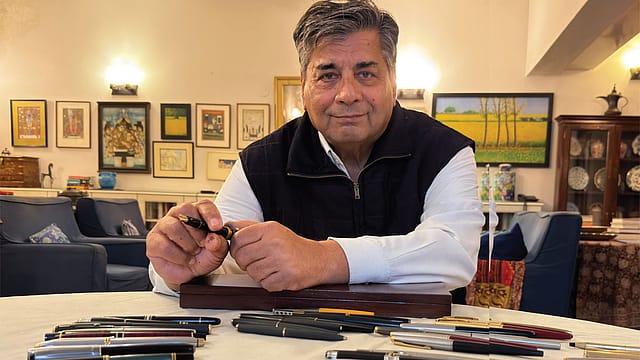
I HAVE LIKED COLLECTING PENS FOR ABOUT AS far back as I can remember. In the early years it was not pens in particular but any kind of writing instrument, including lead pencils. Over the years this evolved into different kinds of pens and then refined itself to just fountain or ink pens.
Perhaps the thing with fountain pens began in middle school around Class IV or V when the great transition to ink from lead pencils took place. In my time ball pens were becoming available but were frowned upon and banished from all schoolwork as being ‘bad for handwriting’. The transition to ink pens was not easy— they leaked; nibs broke, and they required some amount of careful handling which was anathema to careless schoolboys.
But they were more exciting and also fun. For one, an ink pen added a more refined stratification to what otherwise appeared as a homogeneous class of students, especially when compared to the relatively egalitarian world of lead pencils. In the mid and late 1960s, even at the height of the licence permit raj, my recollection is of a wide range of fountain or ink pens available to school students. There were also the select few who could show off a foreign brand—the Japanese Pilot; the Chinese Wing Sung (generally looked down upon); and more rarely the Sheaffer or a Parker. I regret that I did not pay much attention to the Indian-made brands or retain a few. A Wing Sung has somehow mysteriously turned up amongst my pens—I cannot recollect whether it is an old survivor or a newer acquisition.
The other big difference was that pens needed a supportive ecosystem of inks— and there was some choice available here too, adding diversity and difference rather than just the monotonous black of the lead pencil. There was also a need for blotter pads and blotting paper. During my years in school the latter was easily available in most stationary shops. But it was the blotting pads that were most sought after. For some reason these were a favourite of pharma companies and I recollect visits to doctors provided a useful opportunity to try and extract some of these.
Pens and ink were always conjoined for me. Perhaps this had much to do with RK Narayan’s description of the English teacher’s father’s love of ink in the book of the same name. The father used a steel pin with a “fat green wooden handle”. He used to make his own ink “from a recipe which was exclusively his and of which he was immensely proud”. He would make up his store of ink once a year and Narayan’s description of the solemn ceremonial process in The English Teacher shows him at his narrative best.
The ink-making day in Narayan’s description would begin with a family visit on bullock cart to the nearest town some fifteen miles away where all the ingredients for the ink were purchased. Back home, where all the servants of the house had been mobilised, a large brick kiln was erected in the open for the purpose and the day spent in stirring a cauldron in which the ingredients sizzled the whole day—then boiled, distilled, and strained. Enough ink for the whole year would be made and then stored in large mud jugs. The ink had a greenish tint and the English teacher noted, “[M]y father seemed to appreciate it for that very reason.”
Narayan does get the English teacher to pose the question: “I don’t know why my father took this ink business so very seriously, when we could buy all the ink we wanted at the shop and saved ourselves all bother.” But very evidently this is a question that did not merit an answer. I have read and read the ink-making paragraphs in The English Teacher many times. They convey much more than the charm of a world long gone in which things moved in slow motion. Like so much else in Narayan, the English teacher’s ink-making father is a narrative of small habits and integrities holding their own when everything else is changing.
By the time I finished school, fountain pens were well on their way out. Ball pens were more convenient, cheaper, and the risks of damage to the nib of the fountain pen or its ink-filling mechanism did not exist. Also, now available—incrementally, of course—were the rollerballs. This retained the feel and flow of the fountain pen with all the convenience of the ballpoint.
Nonetheless, I retained a strong residual interest in the fountain pen although I may have used it less. It was perhaps around this time that it registered that my father also had an interest in fountain pens which was akin to a small passion. I suppose I should have realised this much earlier since my father always had a few pens around him. I did not notice that when most others of his contemporaries shifted to ball pens or rollerballs, he remained loyal to fountain pens while also using the former. But what I registered was that using fountain pens was not about using any functional writing instrument. It was also making a statement about using just the right instrument. The subtext was that the act of writing—no matter how mundane or banal its immediate purpose—was important in itself.
My father was particular about the pens that he used. For, the ball pens and rollerballs had to be just the right weight, feel and balance. For fountain pens, the standards were more onerous: first, the nib had to be broad—as broad as possible. Second, the nib should be designed to take a lot of pressure. Put together, all this meant the choice of pens available in India was limited.
Bibek Debroy and Sovan Roy’s Inked in India (2022) relates the fascinating story of fountain pens in modern India as a kind of allegory of the decay and decline of manufacturing in the country. By the 1970s, good domestic brands were becoming rarer. For people like my father this meant a relying on difficult to get and very expensive foreign pens. But he did assiduously build up a small collection of the Mont Blanc, Parker, Sheaffer, Waterman, and other brands—fountain pens, ball pens and rollerballs—but there was never any real question that the fountain pens were the most prized and treasured apart from being the numerical majority. Some of these were acquired during rare visits to Europe or the US; others were gifts from returning relatives or close friends. Some dated to an earlier age when freer imports and a better exchange rate had made it possible for even a modestly paid civil servant to acquire a foreign-made pen in India. All the pens that were bought were used and used regularly. None was super-expensive or in any sense a collector’s item. The basic functionality of the pen was evident throughout.
What explained this inclination for fountain pens? To an extent the answer is obvious—he had used these all his life and may have been too set in his ways to abandon fountain pens and switch comprehensively to ball pens or rollerballs, even though his contemporaries had. However, I don’t think inertia or resistance to change is the real explanatory factor.
To an extent it was certainly a kind of vanity in a lifestyle not otherwise given to expensive tastes and indulgences and which could even be termed as austere. Reasonably expensive pens were my father’s only real indulgence. I now think this had much to do with his self-image as a person who liked reading and would have liked to have written more. He was successful in his career as a civil servant, even passionate about it and altogether deeply engaged with its every aspect. But I wonder whether using fountain pens reminded him of what he could have been if he had not chosen the path that he finally did— perhaps a more literary lifestyle, even a slower, quieter, and more provincial one.
I INHERITED MY FATHER’S small collection. Some of the fountain pens still work as if they were new, especially the old Mont Blancs, the Parkers, and the Sheaffers. Inheriting these meant I had to look after them, but it also meant that they reignited my inclination to use fountain pens as much as possible. For about four decades now I have treasured all the pens that were passed on to me and the ones I acquired myself.
I was hooked. I had, of course, many more opportunities to acquire pens than my father had. A career in the Foreign Service meant I travelled a fair amount and on virtually every trip I would try to acquire a fountain pen. But the availability of pens transformed for other reasons also.
I first got a whiff of this change in 1997 or 1998 when Mont Blanc opened its first store in India and in Delhi. Even the entry-level ink pen was far beyond my reach but the store provided a peephole into a universe that we had so far only accessed while travelling abroad. In time I acquired some good Mont Blancs of my own—picked up as bargains in the UK or the US. But the best in my collection are those which my father had acquired— some dating back to the 1950s.
The Mont Blanc store in Delhi was just the start. Change appeared even more significantly when William Penn opened its store in Bangalore at the turn of the millennium and then in Delhi by the end of its first decade. Despite its name invoking the founder of the state of Pennsylvania in the US, William Penn is a homegrown enterprise and it brought the top international brands of pens and inks—American, German, Japanese—to India. All these were now available at the swipe of a card— expensive but easily available. Fountain pens and fine inks were no longer the niche hobby of a microscopic few but represented an emergent new aspirational India, even if highly stratified.
When William Penn acquired the iconic US brand Sheaffer in 2022, at one stroke fountain-pen users in India felt they were not on the fringe but closer to the global mainstream than ever before. Alongside this globalisation was the return of Indian brands. They were much cheaper but now also very good.
At least two of these Indian brands rode successfully on an earlier history. Ratnam Pens in Rajamundhry had made its first pen in the early 1930s in response to an appeal from Mahatma Gandhi that a wholly Indian-made pen be crafted. In Calcutta, Sulekha Ink began production also largely as part of the same Swadeshi impulse and at Gandhi’s request. Sulekha Ink was once the market leader in India but went through a long decline which was almost like a metaphor for what happened to industry in West Bengal. It has recently revived and now Sulekha Ink offer a wide range of shades—easily over 30. History is however always invoked— they have a Jamini Roy series of inks; a Shraddhanjali series after Satyajit Ray; a Swaraj series, and others. They have also added fountain pens to their portfolio.
But pens and the ecosystem of inks in India are now more than old Swadeshi. CLICK Pens in Indore invokes customer satisfaction and new technology and offers a range of fountain pens that were certainly not to be envisaged two decades ago. But there are smaller enterprises investing in the culture of fountain pens. Koliketa in Calcutta makes a range—about a dozen hues—of striking inks some of which are also scented.
These are stray examples—instances of what I have come across. The point is that the ecosystem of pens in India is growing in terms of manufacturing and availability and also in terms of a greater acceptability of why some may still choose to use what is a remnant of the past.
I am not a Luddite. But I use my pens for the first draft of almost everything I write. Sometimes, over the course of a page or even a paragraph, I may use two or three or even more pens and correspondingly an equal number of different inks. Thereafter, transcribing on to the computer gives me, I feel, a more finished product.
Do I use my pens simply because I have them? Or is there some real utility that I derive in writing longhand in ink? It is not an easy or convenient habit or interest to keep up. Fingers and clothes are frequently ink-stained. Pens can be the cause of great heartbreak when they are damaged (a nib breaks quite easily if a pen drops to the floor) or lost. Although I have a modest—by the standards of fountain-pen enthusiasts—collection, cleaning, drying and generally maintaining them and keeping them in working order take a fair bit of time.
So, for what? Most of the time I do not think about my pens in utilitarian terms or about the supposed advantages of using them. But if a utilitarian motive must be identified and found, it could be argued that using a fountain pen helps me slow down all that is happening around me, so what I finally put on paper is more considered and reflective. I sometimes think that the poet Ted Hughes in his celebrated poem ‘The Thought Fox’ was describing just this slowing down of thoughts and the mind till the essence gets written on a clean sheet of paper: