Peak Palate: Prateek Sadhu is putting the Himalayas on the global fine dining map
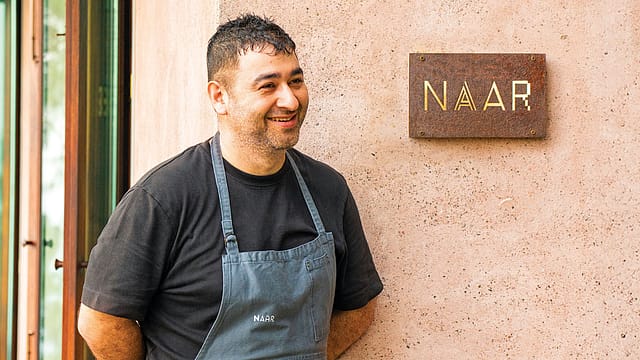
FIRE IS AT the heart of life. It’s the means of creating sustenance, fuelling dampened spirits, protection against the unknown, and in the case of award-winning, world-renowned chef Prateek Sadhu, a metaphor for the raw ambition required to achieve a seemingly impossible dream. His 16-seater fine-dining restaurant Naar—which translates to ‘fire’ in his native Kashmiri—in Kasauli is proof of that.
Nestled amidst the cloud-laden, snow-clad high peaks of Himachal Pradesh, Naar is unlike any other eatery in India. It is built on a vision that marries tradition with innovation, foraging with planned artistry, and local knowledge with global curation. Most importantly, it attracts discerning customers from across the length and breadth of the country, despite the arduous journey involved in getting there (a three-hour drive along unpaved mountain roads from the nearest airport in Chandigarh). Naar can be solely credited for bringing the concept of destination dining to India’s consciousness.
On a balmy winter afternoon, far from his beloved mountains, Sadhu offered a curated taster of the in-house spices and ingredients which bring his famed dishes to life. This one-of-a-kind workshop was part of the ‘Journeying Through the Himalayas’ festival in December, at Delhi’s Travancore Palace. Sadhu, aided by executive chef, Kamlesh Negi, whose origins too lie in the hilly regions of Uttarakhand, dished out a variety of spices and sauces for attendees to sample. Even seasonal flowers with delicate flavouring were on the menu. The goal was to demonstrate how every seemingly minor ingredient, whether salt or seasoning, herb or dressing, adds to the uniqueness of Naar’s food. Sinki, an orange salt made by crushing fermented radish, took centre stage. Hemp seeds (sans cannabinoids) became essential cooking ingredients. “We also use local produce that others avoid—like cactus plant and stinging nettle. Cactus is traditionally eaten in Mexico, so we experimented with the local version too,” shared Negi. Their self-proclaimed quest is to marry what has always been made in the mountainous belt of India with unusual but locally found edible roots, tubers, herbs, fruits and vegetables. At the forefront of this creative endeavour is Sadhu, comfortably donning his role as a young and dynamic ambassador for this region.
“I’m a Kashmiri. My love for the mountains is well known to the world, and I always dreamt of having a restaurant in the mountains,” Sadhu says. Yet, Naar is a sum of the many parts of the chef’s life and work that preceded its opening. Having left the beauteous valley of Kashmir in the early Nineties, as a child owing to militancy in the region, Sadhu watched his mother hold on to their cultural traditions through her culinary skills. Later, abandoning his dream of becoming an Indian Air Force pilot, he enrolled in a hotel management course at the Institute of Hotel Management in Gurdaspur, Punjab. This is where the accidental chef found his way into the kitchen and his true calling in life.

The hallowed halls of the Culinary Institute of America came next, where the double gold medals he was awarded made way for stints at some of the world’s best fine-dining kitchens. Beginning with Alinea in Chicago, The French Laundry in Washington and Le Bernardin in New York, Sadhu made his way through a number of Michelin-starred restaurants across Europe, including the famed Noma led by Rene Redzepi in Copenhagen. This is where he discovered the joy of sourcing and highlighting local ingredients creatively.
With many accolades under his belt, Sadhu turned his sights on India. While helming restaurants in The Leela Palace chain of hotels, he met restauranteur Aditi Dugar, then a home caterer, with whom he embarked on a career-changing path. Their shared vision of using purely local ingredients to create seasonal dishes resulted in the immensely popular restaurant Masque in Mumbai, which has consistently featured on best restaurant lists in India and Asia since opening in 2016. For it, the pair travelled across the country making connections with local farmers to source the best regional produce.
Six years after its launch, Sadhu made news when he quit Masque in 2022.What would pull a chef away from the super successful project he nurtured from scratch? “We all need to evolve,” Sadhu muses. “If you are not evolving, it’s a problem. I believe that success can have many definitions, but for me, it is evolution.”
Meeting Deepak Gupta, the owner of Amaya, a boutique resort located outside Kasauli, became the turning point. Sadhu and his team, which includes his wife Aashina Kaul, moved lock, stock and barrel to this remote location to set up a research lab and pantry in an abandoned cowshed on the edge of the 25-acre property. Here, he experimented with foraged and locally sourced produce, played around with fermented pickles, home-made sauces and created unique combinations to flex his culinary creativity.
“When I moved back, I knew that India was a gold mine of ingredients. But we weren’t taking our cuisine to the next level. I knew that at some point we had to move beyond butter chicken, which was invented half a century ago! It’s sad to be stuck in this mindset,” shares Sadhu.
HE INSTINCTIVELY understood that an evolution would mean looking back and creating with techniques and ingredients that have long existed under our very noses. Research was the backbone of this ambitious project. Once he left Masque, Sadhu travelled around India extensively with the aim of discovering things hedidn’t know. “I came across concepts and ingredients which I never believed we had in India. I started rediscovering my own country. That was really where the shift happened in my life,” he smiles.
Thus, a long-harboured dream came to life. Naar, with its seasonal menu, allowed Sadhu to combine his global culinary expertise with local knowledge and plenty of experiments based on trial and error. One samples the offerings through a robust, multi-course tasting menu to be savoured over a three-hour period.
Depending on the season, one may try a dried Kashmiri fish known as hokhegad, marked by its strong smell, which was Sadhu’s childhood tiffin snack. It’s reimagined at Naar as Dirty Toast, made with fresh trout. You could sample askali, a quintessential Himachali snack, filled with the unexpected smokiness of yak cheese or duck. The aforementioned cactus could be served, as a tiny tart enhanced with buckwheat and mango and tempered with sinki salt. One may also find brined pork accompanied by Himachali apples as well as bamboo shoot pickles native to Sikkim, apricot jam and hemp seed chutney. Smoked neck of lamb, flavoured with juniper leaves, served with Kashmiri mushqbudji rice and egg yolk is another popular dish. The menu can be paired with exclusive wines or cocktails made with local herbs and berries, curated by renowned mixologist Samarth Verma.
The menu changes according to the six seasons of the Himalayan region: early winter, deeper winter, spring, summer, monsoon and autumn. “As nature changes outside, so do our plates, to rightfully represent the six unique seasons of the Himalayas,” he says.
The journey has been exciting but certainly not easy. As Sadhu explains, “In India, we don’t appreciate this kind of creativity in food. Or more likely, we don’t know about it. There are stereotypical ideas where people in the south of India feel that north India has just two things to offer, and vice versa. But there is such immense variety in every region, which people don’t know about. It blows your mind.”
One wonders what induced Sadhu to take on this enterprise. “It was definitely risky—perhaps the riskiest move ever made in the Indian food and beverage landscape,” he laughs. “But I’m a firm believer—the bigger the risk, the bigger the rewards. And it worked!” He credits the interesting cusp of economic development at which India stands today for the success of his innovative venture. Higher disposable incomes, people eager for new experiences, and food tourism picking up slowly but surely are some others.
What Sadhu doesn’t mention, though equally important, is the attraction of the narrative he feeds his patrons. The wide-ranging and unique stories from the Himalayan belt—from Kashmir to Arunachal Pradesh—accompany these delicious meals. It’s a tale of preservation, creativity and culture told through food.
While most chefs would rest on their laurels at this point, Sadhu isn’t like most chefs. “We haven’t even started on our grand plans,” he says. “There’s lots in the pipeline—lots to learn, lots to research. The ultimate dream is to put India on top of the culinary world.”