Past in Motion: An exhibition in Delhi maps trade and cultural exchange in an ancient world
THEY KEEP turning up in the red soil of Tamil Nadu, in places like Karur and Madurai. Small bright coins stamped with the faces of Roman emperors who have never set foot in India. Archaeologists have been finding them for decades. Along the South Indian coast, fragments of wine jars and amphora hint at traces of a trade that once linked the Mediterranean to the Indian peninsula. One could simply label it as commerce—pepper exported for gold. But the coins suggest something longer and older than a mere transactional deal. They hint at a relationship.
That is the thread running through Shared Stories: An Art Journey Across Civilizations Beyond Boundaries, an ongoing exhibition in Delhi. Curated by visual artist and director of the Italian Cultural Centre, Andrea Anastasio, and Laura Giuliano, senior curator in charge of the South India Art collection at the Museum of Civilizations in Rome, it brings together about 120 artefacts from across Eurasia, moving from the Mediterranean to Central Asia, across India and further East. The idea is simple: cultures did not grow in isolation but borrowed and adapted.
The timing of the exhibition is thoughtful. “At times, the world becomes divided, and violent narratives set communities and countries against each other,” says Anastasio. “We felt it was important to underline what has been shared by different civilisations.” Wars and invasions may shape history but they do not tell the whole story. There have also been periods when people travelled, traded and learned from one another.
The exhibition makes its argument through objects rather than claims. One panel focuses on a simple motif: two birds with their necks intertwined. This appears across a wide region, from West Asia to India and Central Asia. In some places, the motif suggests power, in others, love and harmony. The image travels and the form stays recognisable but its meaning shifts.

This is how Shared Stories works, following the movement of motifs and objects. “We wanted artefacts that could express the idea in a clear and poetic way,” he says. The choice of what to exhibit is deliberate and so is the choice of what to omit. The Museum of Civilizations is home to a huge collection but objects that never travelled were not included. “Not just for the obvious limitations given by the logistics but also because we decided to leave out what didn’t travel from one country to the other and remained as a specific element in time and in geography,” Anastasio adds.
Much of that movement happened along routes like the Silk Road. There were also sea routes linking the Red Sea to the Indian coast, caravan paths across Central Asia, and smaller local networks. Merchants, monks, envoys and artisans travelled along them carrying goods, stories, techniques and beliefs. For instance, the game of polo likely began in Central Asia, but was shaped in Persia, and then spread across Asia. It reached China, Korea, Japan and Mughal India. The hookah tells a different tale—a Persian water pipe that travelled across South Asia and became part of everyday life in many regions. What starts in one place rarely stays fixed.
Stories travelled too. The tale of ‘Laila and Majnu’ began in Arabia and was later turned into a Persian poem by Nizami. And then, it spread across Central and South Asia. Each retelling added something new. “Objects change meaning as they travel,” says Anastasio. “Often, the meaning gets more layered with nuances or different aspects. At times they lose the original meaning to assume new ones, other times they share basic aspects. What is interesting is that sometimes the object symbolising a specific theme travels back to the place of origin, assuming new contents and new meanings.”
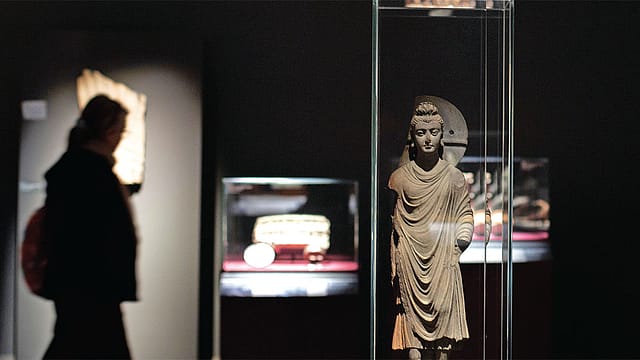
For India, the section on Gandhara art is striking, showing a mix of influences. Carved figures blend Greek styles with Iranian and Indian elements. In some sculptures, Herakles (or Hercules), the Greek/Roman demigod, appears as Vajrapani, a figure associated with the Buddha. Local deities also find a place within Buddhist imagery. The result feels natural rather than forced.
Anastasio also talks about the figure of Hariti, whose story began as a child-eating ogress. In Buddhist contexts, she transforms into a protector of children. Anastasio draws attention to maternal figures in the Mediterranean and later Christian images of the Madonna and Child. The forms echo each other, even if the meanings are not identical. The exhibition keeps returning to such shifts.
AN INDIAN IVORY figure found at Pompeii, buried by the eruption of Mount Vesuvius, sits alongside other objects that travelled long distances. Amphorae found in South India point to a taste for Mediterranean wine. Roman coins found in India show sustained contact. “When I think of these objects,” Anastasio says, “I am reminded that we have been connected for many centuries.” There is also a quieter point about how knowledge was shared, texts were translated, religious ideas crossed languages, and artisans adapted techniques from elsewhere.
Shared Stories also questions how history is taught—as separate stories, tied to nations — urging viewers to see it differently. “There have been enlightened rulers and enlightened times where civilisations would talk to each other, get inspired by the others, where frontiers were not walls but permeable membranes through which traders and travellers would be the carriers of new ideas, religious cults, precious objects, spices, etc. The exhibition is a tribute to all that,” Anastasio says.
There is also the contemporary debate about cultural ownership. Cultures have always been shaped by mixing—food, language, rituals and art. “We know that history can be transformed, moulded, twisted into narratives that might be useful to justify or even to motivate our agendas,” he adds. “If we wish to overcome traumas and wounds, we shouldn’t endure narratives that amplify divisions and conflicts.”
In its final sections, the exhibition focuses on how motifs change in meaning and significance from one region to another. In East Asia, some are linked to good fortune. In Tibet, they enter religious art. In Europe, they are adapted to local styles. The exhibition recalls a past when India was an active participant in global cultural exchange. The ivory at Pompeii is one reminder. The spread of practices and stories is another.
Anastasio recalls visiting the underground levels of St Peter’s Basilica. Beneath the church lies the Vatican Necropolis. The tombs are decorated with a mix of Egyptian, Greek and early Christian imagery. He describes them as, “A plethora of myths and cults witnessing the cosmopolitan Rome of that time. Many of those pictorial themes and subjects re-surfaced in the Renaissance and early Baroque times, and were incorporated in Christian iconography.”
India has its own instances of this layering. Religious and artistic traditions have absorbed outside influences. The Mughal period offer many examples and earlier periods show similar patterns. The exhibition does not try to encompass everything. It offers glimpses that are enough to make the point: objects travel, meanings shift and ideas return in new forms. The past looks less like a set of boxes and more like a web of connections.
(Shared Stories: An Art Journey Across Civilizations Beyond Boundaries is on view at the Humayun’s Tomb Museum, New Delhi, till May 30, 2026)