Mudslinging Time: A proposal to hold a coastal buffalo race has ignited a culture war in Karnataka
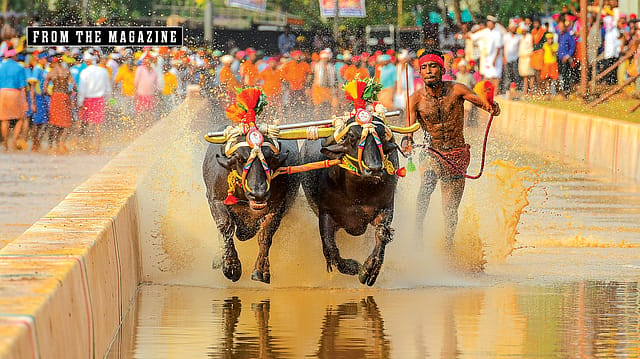
KAMBALA IS A buffalo race run in the flooded paddy fields of coastal Karnataka. A pair of animals, yoked together, is driven down a track of slush by a man holding a rope or balanced on a plank behind them. This year, even as the rains have largely failed, the state government wants to bring Kambala to Mysuru. The proposal to showcase the coastal buffalo race at Dasara this October, weeks before the season would normally open, at a projected cost of ₹5-8 crore, has not yet received formal approval. But Puttur MLA Ashok Kumar Rai, who is one of those steering it, told Open that it was a “done deal”. “The CM has orally confirmed that the event will happen at Mysuru,” he said. Supporters bill it an extra attraction for the Mysuru Dasara while critics call it an expensive transplant sans original context. Mysuru-Kodagu MP Yaduveer Krishnadatta Chamaraja Wadiyar has objected and environmental groups have filed petitions.
Professor K Chinnappa Gowda, former vice-chancellor of Karnataka Folklore University, says traditional Kambala was far from the organised spectator sport that it is today. It was part ritual, part recreation, held post November, with buffaloes running through the churned mud of fields already ploughed and levelled for the second crop. Now, the professional Kambala calendar runs from November to March, featuring 23-26 events. In non-competitive Kambalas—dozens of them are still conducted across the coastal districts of Dakshina Kannada and Udupi— buffaloes were led around an auspicious post. Milk was offered, the Naga worshipped and prayers made for the land’s fertility. “Consider the irony of transplanting a fertility ritual meant for agricultural land to an urban centre, and in a year when the rains have failed. Not that this would stop capitalism from flooding an artificial mud track in Mysuru,” says Purushothama Bilimale, folklorist and chairman of the Kannada Development Authority.
This act of transporting the race to urban Karnataka is not without precedent. In November 2023, 159 pairs of buffaloes ran on a 155-metre track at Bengaluru’s Palace Grounds, drawing immense crowds. Although the event couldn’t be repeated, support for turning Kambala into a mainstream competitive sport has steadily gathered. The Karnataka State Kambala Association was recognised as a sport body in October 2025 and ₹5 lakh was allocated for each of the 23 big coastal events. Now there is talk of IPL-style sponsorship. Rai reckons the competitive Kambalas each year cost ₹70 crore to ₹100 crore.
The buffalo is not an animal built for velocity. The discovery that it could cross a 130-to-160m flooded field in under 12 seconds is fairly recent. Competition arrived in Kambala by degrees, with racing beginning in earnest around the late 1960s. Soon there were dual tracks and new categories. After the Kambala Committee began codifying rules in 1989, registration, sequenced starts, proof of a finish, cameras and timekeepers came into the picture. “Photo finish came about 20 years ago. Now we have an end point laser beam network system everywhere and we have prototyped a starting point tech in collaboration with AI companies and Manipal University,” says Nandalike Srikanth Bhat, a hotelier from Manipal and one of the sport’s best-known buffalo owners and patrons.
After land reform in the 1970s broke the old feudal order and gave tenants land, migrants from coastal Karnataka prospered in Bombay, Dubai and farther away, and the money came home in search of identity, says Bilimale. It endowed local cultural practices including bhuta worship, Yakshagana and Kambala with the means to go large.
The sportification of Kambala has bred a new digitally networked youth culture the paddy field never could. Alistair Sam Andrade from Manipal is 17 and helps out at Team Naravi Yuvaraj Jain, which won one of the categories at Mangaluru in December 2024. Andrade dates the Kambala craze among young people to the 2017 mobilisation to protect Kambala, influenced by the Jallikattu protests. Karnataka amended the Prevention of Cruelty to Animals Act in 2017 to exempt Kambala. In May 2023, a five-judge Constitution bench upheld that amendment along with those of Tamil Nadu and Maharashtra, dismissing petitions brought by animal welfare activists. In March 2026, the Supreme Court rejected PETA’s attempt to confine Kambala to Dakshina Kannada and Udupi districts, paving the way for the proposed event in Mysuru.
Now even the fallow season is a busy one on on WhatsApp groups and social media, Andrade says. “There’s a near-constant stream of information shared about which buffaloes are ploughing for exercise where. Which team has acquired new buffaloes, the price, the features, pairing, and so on. The youth obsess over every aspect,” says Andrade. The Kambala field never goes quiet, even if paddy fields, where the events used to be held, are giving way to commercial areca plantations.
The team he is associated with is named for Yuvaraj Jain, who was a jockey for some 35 years, until he was 66. He won hundreds of medals for the 20-odd owners whose buffaloes he ran with. His career ended when a wooden plank struck his ankle at the end of a race and broke it. In 2020, his son bought two buffaloes. “I wanted him to follow his passion even after he could no longer run,” says Rakshith Jain, who practises at the Karnataka High Court and returns to Naravi, in Belthangady, every Friday of the season. His father looks after the animals, preferring not to hire professional handlers and trainers.
The men buying buffaloes now are not just landlords as was the case in the past but advocates, hoteliers, doctors and businessmen. But the entry price has climbed. Jain puts the floor at ₹10-12 lakh a year for looking after a single “senior” pair (the term for buffaloes with permanent teeth, which corresponds to about six years of age). One can buy a buffalo for anywhere between ₹5 lakh and ₹50 lakh.
Bhat, who has seven buffaloes including one 27-year-old retired champion who won him over 200 medals, says it’s now a matter of prestige for successful people from Karavali to own buffaloes. “We are excited about Mysuru and hope that Kambala will one day happen throughout the year, across the state.” Bhat spends upwards of ₹50 lakh a year on upkeep and training. He has engaged two jockeys for the coming season and is negotiating with a third. Among his runners is Bambranabailu Vandith Shetty, a star with a following of his own. At Mulki in January 2023, Shetty slipped halfway through a race with Bhat’s Kutti and Raja and held the rope. The pair reached the finish in 11.50 seconds a and won the hagga hiriya (or senior rope) category. At Mangaluru in December 2024, Shetty took the same category with Bhat’s buffaloes in 11.86 seconds. “When we win, the whole village celebrates. Manipal’s students come and celebrate,” Bhat says, adding that “with regular trainers and runners commanding high pay and even a fan following, and an urban audience, Kambala has become more democratic.”
As Kambala once again prepares to leave Tulu country, an argument follows it across the ghats. Some argue that tradition has no clean starting line and that ritual and sport overlap. Even at a modern Kambala, runners bow before stepping into the mud. Owners seek blessings at shrines before bringing out the buffaloes. Others warn that once Kambala leaves the coast, what arrives in Mysuru may be missing the essential cargo of context. Meanwhile, Bhat and 50 other owners are already preparing for the road.