Mother across Ages: Botticelli’s Madonna Meets Harappan Maternal Icons
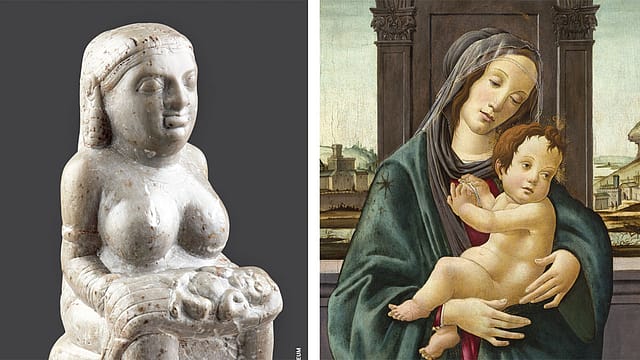
IN A DIM, cool gallery at the Humayun’s Tomb Museum, the only sounds are the cautious steps of visitors on marble, their hushed voices and the click of their cameras. They are busy snapping photographs of the displays, spanning two continents and thousands of years. The oldest exhibits are the terracotta sculptures, around 5,000 years old and excavated from Harappa. These European and Indian sculptures range from terracotta to marble, from life-size to miniature, and though in various forms of decay, are still in good condition. Several of the smaller ones are in glass cases. The only painting displayed in the exhibition is a relatively newer work— Sandro Botticelli’s Madonna and Child, dating back to around 1490, on loan from Florence’s Museo Stibber.
The sight of Harappan and pre-Mauryan statues displayed alongside these classical and ancient Italian works is unusual, even incongruous. So is Botticelli’s painting as well as the stone figures from Etruscan-era Italy, which would almost certainly be normally viewed only in their native country. These original works would usually only be seen after paying high fees and waiting in long queues, and would be displayed behind ropes and prominent ‘Do Not Touch’ signs. There is little that the exhibits displayed have in common—apart from the fact that all of them explore the concept of motherhood, interpreted across regions, cultures and languages.
This is the intent behind One Mother, Many Mother Tongues, an exhibition ongoing at the Havells Gallery in Humayun’s Tomb Museum, New Delhi. Curated by professor of Indian Art and Architecture at Jawaharlal Nehru University Naman Ahuja and director of the Italian Embassy Cultural Centre Andrea Anastasio, the exhibition comprises 27 original artefacts loaned from museums across Italy and India. It is the result of a year-long collaboration between the Italian Embassy Cultural Centre and several state governments. “It all started as an exchange of thought and ideas during a dinner party a year ago,” Anastasio shares with Open. “I spoke to [Ahuja] about his essay, ‘One Mother, Many Mother Tongues’ [published in Marg, 2019], and said it would be fantastic if we could do an exhibition together.” It was decided that Ahuja would focus on the different identities and aspects of motherhood in the Indian context while Anastasio would bring in ideas and iconographies of motherhood from Italian and Mediterranean culture.
Botticelli’s numerous paintings of the Madonna and Child come to mind almost universally when one thinks of motherhood in the traditional European context. The painting on exhibit, though ostensibly a straightforward celebration of motherhood, also contains a sense of melancholy and gravity. The Madonna is not smiling at her baby; she seems withdrawn and is looking inward as though she is aware of her son’s impending crucifixion. Anastasio explains: “This shows a specific, philosophical statement that has broader themes than Christianity. She is aware of the transitory nature of life and she is aware that in giving birth there is also death.”

Anastasio adds that Botticelli’s work refers to an iconography that was already thousands of years old. Take for instance, the Etruscan figures of the Mater Matuta ( ‘Mother of the Dawn’). The figures, though centuries older than the Madonna painting, are just as perfectly formed and detailed. This Etruscan cult and concept of a protector goddess of children pre-dated Christianity as well as the Roman era, and was from a mythology spread over central and southern Italy. “The cult was protecting the mother, and the baby, the new life, but also the rebirth. Morning was portrayed as the rebirth,” says Anastasio.
Closer home, the sculptures from India are just as breathtaking and thought-provoking. Exploring themes of motherhood from Bengal, Tamil Nadu, Rajasthan and Harappa, the exhibits include matrikas like ‘Jyeshtha’ from 8th century AD Tamil Nadu, a goat-headed mother goddess from 1st century BCE and Buddhist guardian figures of the ‘Hariti’. Like their European counterparts, they all have a mother-figure with a child. “One image of the Hariti goddess has children all around her, on her lap and on her shoulders. They are in fact all from different communities: Zoroastrian, Chinese, Central Asian, Roman, Greek, Egyptian, and Hindu. Additionally, this work had been made in a Buddhist monastery,” says Ahuja. He notes this was part of his original paper—the notion that it was one mother communicating in multiple tongues, and was actually being interpreted by different populations and segments in their own mother tongues, and coming to divergent meanings.
Ahuja adds that rather than labour through 5,000 years of objects, he and Anastasio had chosen 27 singular masterpieces representative of each epoch. Anastasio notes, “It was a beautiful collaboration between an art historian who is an academic and an artist who is in a position of running a public institution.”
The wall text and section labels of the exhibition also pose questions of gender and parental roles. These are aimed at making the viewer ask: is the baby a girl? Is there as much importance for parenting given to fathers? Ahuja says, “There are not many temples, churches, and sculptures, with the loving nurturing aspects of fathers, and as mothers as providers.” It is becoming increasingly important to ask these questions in the 21st century. n
(One Mother, Many Mother Tongues is on view at Havells Gallery, Humayun’s Tomb Museum till August 8, 2026)