Masculinity Remixed: Menswear ruled the runway at Lakmé Fashion Week in partnership with FDCI
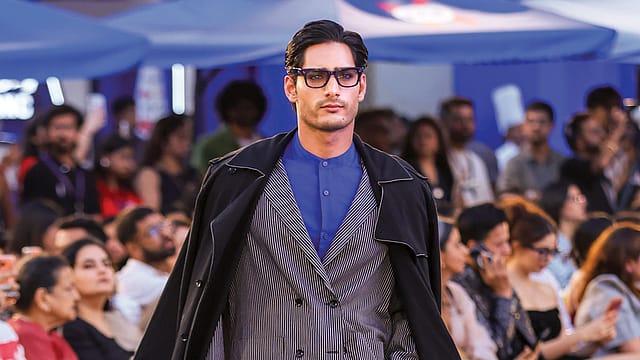
A WELL-DRESSED man is a standout but he has also been something of a rarity. Sharp suits and polished grooming make a good impression, but to be dandy was once the pursuit of a few. Yet, at the recently concluded Lakmé Fashion Week (LFW) in partnership with FDCI, dandies were everywhere. Take Kartik Research, which made its India runway debut on day one. The label, founded by Kartik Kumra in 2021, is a regular at Paris Fashion Week and has fans among the likes of New York Mayor Zohran Mamdani. Kumra recently won the Fashion Trust Arabia’s India guest country award which culminated in the LFW x FDCI show, coinciding with the brand’s fifth year in the fashion business. He assembled Indian textiles and crafts—hand-block printed and embroidered shirts, embroidered denim but also minimalist handloom trousers, silk and zari pantsuits as well as plainer overlays—with restraint and eclecticism, and a genre-defying quality. If not for the delicate lacy embroidery running through them, a black jacket and trousers could pass for work—and perhaps it should, if we are willing to rethink how men can or cannot dress up.
In a comparatively lean calendar of shows, menswear was arguably the most definitive trend emerging out of LFW x FDCI this season. Offerings for men spilled across shows and collections, beginning with the opening show. The Boys Club, presented by FDCI, featured four labels— Countrymade, Dhruv Vaish, Sahil Aneja and Vivek Karunakaran—each focusing on a distinct menswear aesthetic. Sunil Sethi, president of FDCI, who curated The Boys Club observes that opening with a menswear show is a first for fashion week. “It got a lot of attention because everyone realises that the menswear category is becoming stronger by the day,” he adds.
At Abraham & Thakore, where designers David Abraham and Rakesh Thakore collaborated with the lifestyle brand L’Atelier 1664, menswear shared equal space on the outdoor runway with womenswear. “We were interested in rethinking classic menswear silhouettes through a softer, more fluid lens, introducing drape into tailoring and allowing garments to move between the formal and the everyday,” says Abraham. Think short kurtas paired with breezy pants and light jackets, softly-cut pantsuits, bandhgalas over roomy trousers. “The idea was to create pieces that feel relevant across occasions—clothes that are not bound to ceremony, but still carry a sense of occasion in their detailing and construction,” adds Thakore.

Amit Aggarwal’s collection, ‘Orizon’ was sprinkled with menswear for festive occasions and weddings. AFEW by Rahul Mishra showcased multiple menswear designs as did péro which presented this season’s grand finale show. Pawan Sachdeva, who was part of the Navdhara Khadi showcase, created a line of khadi denim designs. At AK-OK by designer Anamika Khanna, an extensive lineup included blue turtlenecks peeking from under white suits with unfinished edges, long fringed kaftans with trousers, soft jumpers and trousers with a hint of embellishments, translating the collection’s fluid silhouettes and laidback luxury to men’s separates. It was also a menswear debut for Payal Pratap whose collection, ‘Memories Pressed in Time ’, showcased denim designs. “Menswear demands a certain restraint. You can’t rely on excess. Every proportion, every detail has to hold its own,” says Pratap. “I find that discipline very interesting. The decision to introduce it came quite instinctively through this collection. Denim carries a certain universality, and many of the silhouettes we were developing naturally moved beyond gender.”
The emphasis on menswear at fashion week reflects a much broader shift in industry and consumer preference. Conventionally, the industry puts women first, as it very well should; the demographic drives consumer demand and product design. In comparison, the codes of men’s dressing have often been boxed in neutral colours and classic tailoring, eschewing the allure of bright colours, prints and trimmings, asymmetry and offbeat
tailoring. It is an aesthetic conditioned by gender norms and often by men themselves. The irony is not lost considering the large number of men who have historically worked in fashion and assumed leading roles as couturiers and creative directors of hallowed fashion houses. Yet, men’s fashion itself has been labelled boring.
Today, the defining term is more likely to be: dapper. Menswear is at its most plentiful and diverse, fuelled by design and product innovation as well as a changing attitude among men when it comes to dressing up “The black, white, grey and blues, and the traditional silhouettes of a well-fitted trouser and shirt or a suit and tie—all those seem to be passé. Not just among millennials or Gen Z but also men who would like to experiment,” says Sethi. “Men are now regular about fitness and they like to look good. Having a good sense of dressing and impressive things to wear are important to them. Look at menswear now—it’s unstructured, there’s a lot of drapery and experimentation, being ‘vocal for local’ stands out. It’s no longer restricted to sherwanis or something for weddings.”
The movement is not just on the runway. At the stockroom, where designers put up stalls showcasing their collections for buyers, menswear had a noticeable presence. On the final day of fashion week, it is customary to have a ‘Stockroom Sale’ for the public to interact with designers and their teams, and buy from them. This season, menswear labels did visibly brisk business. A couple of gentlemen perusing the stores stepped out of one menswear store and wondered where they should go next. “You have all the choices you need, sir. There is menswear everywhere you look,” said one smiling saleswoman, her hand sweeping across the length of the row of stalls.
Sushant Abrol, designer and founder of the menswear label Countrymade, was one of the designers at the stockroom this season. He was also part of The Boys Club, receiving positive reviews for his Spring/ Summer 2026 collection inspired by cenotaphs. At his stockroom stall, another collection was on display. ‘Foundry’, for Autumn/Winter 2026, explores how processes from foundries could be translated into textiles—treated under force, wools boiled to create new textures, knits fused with denim “to form textile alloys”, surfaces compressed and distressed. Abrol notes that his label has been able to “carve out a small, honest place for ourselves” in a fast-moving market. “In the past, menswear was about dressing correctly. Today, it is about dressing with intent. The modern man is no longer looking for a uniform, he is looking for a point of view. That has created space for labels that offer something more considered,” he says. “Countrymade never started as a response to the market. It was a personal reaction. I think that honesty has allowed the work to connect in its own quiet way.” Abrol builds every collection on the bones of previous ones, designing clothes that narrate their own stories (Abrol is also a writer). “What I hope to offer men is something they can relate to on a personal level. Garments that carry thought, evolve with time, and become part of their own story,” he adds. “I’mnot trying to dress the man. I’m trying to give him something he can make his own.”
The attention on menswear is evident in the talent initiatives and competitions too. Anurag Gupta, winner of The Spotlight initiative for emerging designers presented a conceptual line with a focus on men’s designs. Chennai-based designer Varshne B, founder of the menswear label CRCLE and winner of the latest edition of the R|Elan Circular Design Challenge (hosted last year), a platform to spotlight sustainable design innovations, showcased her collection ‘DIALOGUE’ on the runway. CRCLE collaborates with artisans, craft communities and material innovators across India, and works with natural and repurposed materials in its designs. Varshne initially conceived of a unisex aesthetic but found that her designs aligned effortlessly with menswear. “It’s also how I’ve always dressed up, in oversized clothes,” she says. “I wanted to come up with new materials, new handcrafted techniques that can be incorporated in menswear.” Clothing aside, Varshne highlights ties and bags from her label which seek to reimagine how such products are designed for men.
Menswear also recurred at Gen Next, the incubator programme for young homegrown fashion labels and one of LFW X FDCI’s most enduring initiatives. The three designers this season were Jubinav Chadha, who dressed male models in florals from his ‘A Postcard from Valley of Flowers’ collection; Taarini Anand whose FW26/27 collection, ‘On Restoration: Methods for Preservation was inspired by the Ajanta Caves and centred on knits; and SAIM whose conceptual collection referenced Indian mythology, temple sculptures and his memories of Durga Puja in Kolkata. It’s a milestone for designer and founder Saim Ghani who is about to complete three years since launching his eponymous label. He notes that men have approached the label more slowly than women, and the key to finding appeal among men has been to adapt designs in an understated manner without losing their aesthetic appeal. “When men see something extremely OTT or a lot of embroidered and dramatic womenswear, they feel that we as a brand can’t do simpler versions for them,” Ghani says. “As a designer, I focus on construction and certain elements that define the brand. If womenswear has five elements and men may like just one, we are okay experimenting with that. ”
Ghani adds that as men increasingly “want to look as cool as women”, he has seen perceptions changing and less judgment about clothing choices. The Gen Next programme has offered greater exposure and mentorship for brand building, which he hopes to use in growing his retail footprint and the creative scope of the label and who wears it.
Framing this menswear moment is a bigger movement. Outside fashion week, menswear specialists are thriving and designers who previously focused on womenswear are turning to men. Menswear labels are finding favour in global markets even as the homegrown market catches up. Pratap says, “Menswear today is less about rigid categories and more about how people actually want to dress, with ease, fluidity and individuality.” Sethi, who also helms the FDCI India Men’s Weekend, observes that design and product innovations have already come a long way. “Designers have done their bit,” he says. “I am now expecting the consumers to take advantage.”