Mahasweta Devi and Ritwik Ghatak: Relative Values
I keep lining up little pieces of the jigsaw to see if I can read patterns. At some other time, someone who may research him extensively to analyse his films may read how the experiences, reading, people that left a mark on his formative years found their way into his films.
I cannot do that. All I can do is sit and remember when I get a moment—how rare it is when I do—and remembrance consumes me with a sense of emptiness. As if I have lost something very familiar to me. When he was there, I did not know that I would feel so empty that he has won, that he is laughing watching from somewhere that he has won. This is not a childhood game—he has won this completely.’”
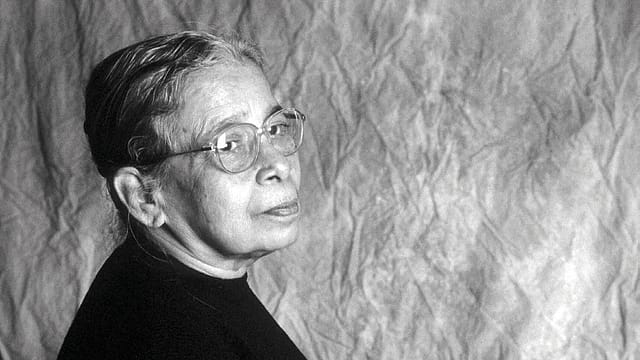
Mahasweta Devi wrote these words about her paternal uncle Ritwik Ghatak in January 1977, roughly a year after he passed. Although he was Mahasweta’s father’s youngest sibling (he and his twin sister Pratiti), less than two and a half months separate his and Mahasweta’s births. November 4, 2025 marked Ghatak centenary, and January 14, 2026 marked Mahasweta’s centenary. They grew up together, not as siblings as much as best friends—Mahasweta, Ritwik and his twin. He died in February 1976, just past 50 years of age. She passed in July 2016, half a year past 90 years of age.
Ghatak left behind eight complete feature films (and three unfinished), three documentaries (two incomplete), nine short films and two books as listed by Shamya Dasgupta, editor of the volume Unmechanical: Ritwik Ghatak in 50 Fragments (Westland, 2025). Mahasweta published more than 100 novels and 350 short stories, calculates Ajoy Gupta, her editor at Dey’s which has the rights to her complete works in Bengali. Her substantive non-fiction writing, including her memoirs and investigative journalism, would add up to half her fiction writing.

My essay, too, is an exercise in pattern-finding. Are there influences and abiding concerns that connect their works? Do they harbour similar hopes from a newly-birthed, independent, democratic nation free of colonial rule? Both Ghatak and Mahasweta were 21 in 1947, adult citizens (the 61st amendment in 1988 brought this down to 18 years of age). Did their shared childhood experiences make their way into their works?
Even after Mahasweta’s wedding in 1949, Ghatak would often stay overnight at Mahasweta’s home with her husband and baby. Her son, Nabarun, was just about a year old then, and she would leave the infant with him while she bathed and ran chores. “It was Ritwik who was my greatest companion around the time of 1949,” she would write in Ek Jibonei, her unfinished (and uneven) volume of memoirs.
Mahasweta and Ghatak’s first independent creative work was collaboration with each other. (They likely produced writing and drawing for school assignments, but the key word is independent, as in unsupervised or authorised by adults.) Both aged 13, they produced an artisanal magazine along with a cousin where Mahasweta wrote a short story copied from Bibhutibhushan Bandyopadhyay’s Pather Panchali, Ghatak contributed a personal essay about his failed romances, and all the illustrations in the edition, and the cousin copied the material by hand for distribution because she had good handwriting. The readership—the Ghatak family—did not encourage subsequent editions, Mahasweta writes.
As adults, Ghatak and Mahasweta never worked together. In an essay for Seminar magazine, Prof Ganesh Devy writes: “She confesses to having no influences, except that she mentions her uncle, the filmmaker Ritwik Ghatak, with a great sense of pride.”
What I find in common in their works is a shared love for nature and landscape, the admiration for the tribal citizen and the indigenous way of life, flashes of childhood memories, and indeed, hints that they were keeping track of each others’ work. Certainly, this is true for Mahasweta, who produced her richest body of work from the mid-1970s to the late 1980s, the decade after Ghatak’s death.
First, the abiding interest in the tribal citizen. This is Mahasweta’s
province in a sense—to those who do not read Bengali, she is known primarily for her many, many works featuring the Adivasi, both fiction and non-fiction. Prominent among these is her novelised biography of Birsa Munda, Aranyer Adhikar, translated into Hindi as Jangalke Daavedar, her beloved short story ‘Draupadi/Dopdi’, and celebrated stories like ‘Seeds’, ‘Rudaali’, the novella Operation? Bashai Tudu and her reportage and op-eds on bonded labour and denotified criminal tribes.
ut Ghatak’s interest precedes hers. In 1955, he released a 14-minute long documentary titled Adivisayon ka Jeevan Srot, commissioned by the government of Bihar and distributed by Films Division. It was screened across India before film shows in theatres, as was the norm with Films Division documentaries, the scholar Sanghita Sen writes in her essay in the anthology Unmechanical: Ritwik Ghatak in 50 Fragments. In 1957, he made another documentary titled Oraon, which Sen says, is unfinished. “I have been spending the whole day with Oraon and Munda people,” she quotes from a letter he wrote to his wife Surama, “feeling the taste of the soil, experiencing the extraordinary music and the enthralling rhythm of their dance the whole day… My wish is come back again to make a bigger film with more of this reality. ”
In 1958, Bimal Roy’s Madhumati was released, a blockbuster then, and now recognised as a Hindi film classic. The film gathers a cohort of legends—led by Roy as director, actors Dilip Kumar and Vyjayanthimala Bali, music composer Salil Chowdhury, poet Shailendra, and Ghatak who wrote the story. Remember the character played by Vyjayanthimala in the first part of the film? She is from a tribal community living in mountainous terrain—the site of a timber plantation. Even those who may not have seen the outstanding film may guess this from the foot-tapping ‘tribal number’ (Hindi film has a tradition of these pulsating songs) ‘Bichua’. And those who have watched the film, would know the thrilling climax he hands to Vyjayanthimala’s Madhumati. She stands for all that is natural, beautiful, strong and unconquerable. In his now celebrated film Ajantrik (1958), about a man’s love for his car, Ghatak set his story amid tribal people, revisiting the landscape where he worked on Adivasiyon ka Jeevan Srot. There is also Subarnarekha (1965), whose very title refers to the land of the river called Subarnarekha that flows through present-day Jharkhand. Here, we see the beautiful, desolate landscape of the Chota Nagpur plateau inhabited by major tribal groups such as the Santhals and the Mundas.
Mahasweta’s first work to feature the Adivasi is Aranyer Adhikar on Birsa Munda’s life. It was published 1977, the year after Ghatak died, and secured her the Sahitya Akademi award. It marked the beginning of an interest that lasted till the end of her life. In the 1980s, she would set up the Palamau Bandhua Sramik Samiti, an organisation for bonded labourers, the majority of whom were of tribal identity.
Samik Bandyopadhyay, the theatre and literary critic and translator of Hajar Churashir Maa (Mother of 1084, 1974) writes in Anandabazar online that Mahasweta had heard from Naxals in Calcutta after the publication of her landmark novel. “You have written a moving novel, but you don’t understand Naxalite politics.” One (unverified) view is that this comment came from Nabarun, her estranged son. Mahasweta dived in to understand the ideology, choosing to go to the rural roots of the movement.
Intellectual interests are hard to pin down in specific terms. It is likely that Mahasweta admired Ghatak’s films and listened to his stories with attention, and the interest in tribal life began there. It would be unintelligent to insist on this. What can be objectively stated, though, is that the admiration for tribal culture runs through their works. In Mahasweta’s hero Bashai Tudu, who keeps turning up alive after being declared dead, I see the spirit of Ghatak’s Madhumati, armed with Mahasweta’s wicked sense of irony.
The second thread that binds their work is the refugee colony. Ghatak’s celebrated Partition trilogy features refugees from erstwhile east Bengal in independent India. Meghe Dhaka Tara (1960), the most beloved of these and the first in the trilogy, tells the story of a family living in a refugee colony in Calcutta. The poster of the film, featuring heroine Supriya Chowdhury, looking out from the distinctive diamond patterned, plaited bamboo-like structure of the homes that refugee colonies are associated with. In Komal Gandhar (1961), many of the members of a theatre troupe are refugees, yearning for their homes they have left behind. But the film is not set in a colony like Meghe Dhaka Tara is. In Subarnarekha (1965), the film opens with a flag-hoisting ceremony in a similar colony with these precarious but curiously beautiful thatched homes. Although it quickly moves to a factory setting in the Chota Nagpur region, the film is peopled with characters from this refugee colony.
In Hajar Churashir Maa, the second section titled Afternoon unfolds in a refugee colony in south Calcutta. The superbly structured taut novel unfolds over the course of one day in the life of Sujata, two years after the murder of her youngest son Brati, the corpse numbered 1084—with sections titled Morning, Afternoon, Late afternoon and Evening. Afternoon is when Sujata visits the home of Somu, Brati’s friend who was murdered alongside him, who lived in the colony.
For several years, Mahasweta herself lived in a refugee neighbourhood—Bijoygarh. From 1964 to the early 1980s, she taught at the Bijoygarh Jyotish Roy College. It was this area that she captured in Hajar Churashir Maa, she notes in Ek Jibonei. “Today’s Golf Green is where they would dump corpses the other day. There, ponds, field rats who dug up mounds of earth, poisonous snakes, saibabla trees and the corpses all lived together.”
hird, is the shared affinity for nature. In Ghatak’s case, this is joyously apparent—in the way the screen appears to drink up the beauty of nature in the Tagore song ‘Akash Bhora Surjo Tara’ in Komal Gandhar. Or, the gently swaying paddy crop towards the close of Subarnarekha, as another beloved Tagore song plays out ‘Aji Dhaaner Khetey Roudra Chhaya’. Consider also the reverence and attention with which Ghatak films trees in Meghe Dhaka Tara, often standing protectively over his frames and his protagonists. Madhumati films trees with similar care. Indeed, the camera often seems to be caressing the intricate, beautiful barks of the trees as human hands would. I’ve often wondered whether Madhumati marks the first of Indian films with an ecological conscience.
Mahasweta would count among the first Indian writers, whose writing carries ecological concerns. Her writing on the environment—on subjects such as the non-native eucalyptus tree, pushed by the forestry department, which kills native flora and fauna, and the incidence and effects of silicosis and asbestosis among the local populace (including cattle) in Jharkhand—dates to her reportage across eastern India in the 1980s. To my mind, her work counts among the earliest reportage on the silicosis-asbestosis problem in India.
And, she brings this formidable, scientific knowledge of the natural environment to her fiction—in the short story ‘Salt’, she lists the many medical conditions that affect the human body when denied salt in the diet, and how vital it is to non-human species like elephants and deer. Her phenomenal knowledge of trees is displayed in several books—Operation? Bashai Tudu, Aranyer Adhikar, among others.
This is a different order of love for nature from Ghatak’s bounteous enjoyment of it. Mahasweta brings a forensic eye to her reading of what the Indian state and market are doing to our natural resources. Yet, for both, the affinity for nature likely comes from a love of Tagore. Mahasweta studied in Santiniketan from 1936-38 when Tagore was still alive, a time when classes included caressing the barks of trees to identify them, observing the insects and birds living on them, swimming in the river.
And there are, of course, experiences, encounters and people from their shared childhood and youth. A brief sequence in Subarnarekha is often mentioned in discussions of the film. As a child, the heroine Sita encounters a bohurupee—a folk theatre performer—dressed as Ma Kali with a terrifying tongue and takes fright. When the gentle old man accompanying her gives the performer a coin and tells him off for scaring a child, he takes off the fearsome tongue, and replies that they had suddenly crossed paths. He had not intended to scare her. In her essay on Ghatak the year after he passed, Mahasweta mentions this incident from their childhood. They were watching the street from the verandah, when a passing bohrupee terrified them. Her father gave the performer a coin and told him not to frighten children. “But this is my work,” he replied. “How else will I earn?”
Perhaps, there is more, and I haven’t seen those pieces yet. Perhaps, someone who knows both their work closely will locate all the pieces of the picture, as Mahasweta wrote for Ghatak. What I noticed was a set of resonances between the page and the screen, as if two friends who loved and admired each other very much had carried over their conversations to their films and books. So I listened and took notes. Listen, and you may hear them, too.