Living the Dream: Pioneering designer Pinakin Patel gets a fitting retrospective in Mumbai
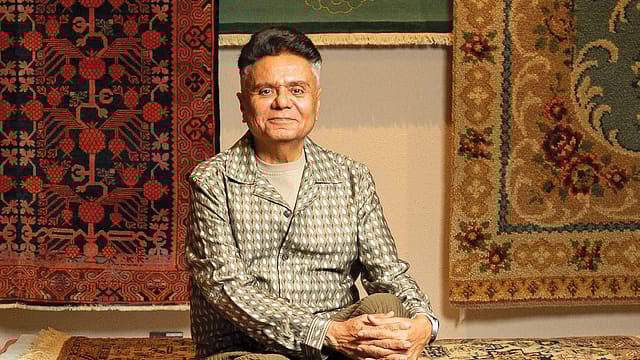
ON A RECENT Sunday morning, as fitness-conscious Mumbaikars spill out into the streets to run a marathon, a motley crowd of the city’s aesthetes and (dilettantes like this writer) have gathered at Nilaya Anthology’s atrium-like gallery to hear Pinakin Patel talk about what he loves talking about—art, architecture, design and decor. Witty, restless and self-effacing, Patel is not as much in awe of himself as others around him seem to be. He’s the kind of guy who makes the walkthrough of his own retrospective fun and engaging and not didactic. “Am I so old?” he jokes, eliciting a bashful smile.
Someone murmurs that Patel now rarely leaves the verdant comforts of Alibaug, where he has lived since 1999 after bidding adieu to the unbearable bustle of Mumbai and settling into a dream-like existence in the sleepy village of Chondi. But here he is—the proverbial SoBo lad, now 72, returning to make peace with the city of his birth and boyhood, driving through a neighbourhood that was once a mill district and transformed into the Shangri-La of urban living, stumbling into old friends and clients along the way and embracing bouquets and brickbats with equal grace. “I am not a person who dwells either in the past or the future. I am a man of the present,” says the septuagenarian whose retrospective, The Turning Point, honours five decades of his work, spanning interior and furniture design, home decor, architecture and particularly, his unerring eye for beauty and passion for art. Walking into the retrospective, long-time followers of Patel’s work will be struck by a familiar vibe while it might feel like a discovery or revelation to those less informed about design.
Start with the constellation of 11 key pieces that adorn Nilaya Anthology’s main gallery where a diffused, natural sunlight filters through the roof, illuminating some objects while leaving others virtually untouched. All the displays are from Patel’s archives, symbolic of his lived experience as a self-taught designer who has always preferred the “essentials of life,” as he calls it, over things that are not necessary. Patel’s idea of minimalism is firmly rooted in ancient Indian aesthetics, which he has tried to contemporise and reinterpret through an Indian Modern work.
With nods to the traditional Gujarati gadda and Mughal-style takht, the ‘Takht Sofa’ is a typical example. The success of this furniture prototype hinges on a seamless blend of functionality, accessibility and meaningful craftsmanship— the result is a piece that combines the Indian way of living with a contemporary lens. “We live in a tropical country, half the time I wear slippers at home. So, I take off my slippers and quietly climb onto the sofa, I slouch, somebody else comes and joins in. It’s not so intimidating, you see,” he says. “All the four corners of the sofa are open. It can accommodate the needs of the entire family. It’s like a conversation pit or a baithak. Somebody wants to tuck in and play cards. In the afternoon, someone wants to take a siesta and not go into the bedroom for it. On weekends, your guests come so it becomes an extra bed for them.”

Similarly, the Vrindavan-inspired ‘Jhoola Bed’ was originally designed for Patel’s collaboration with Good Earth. “Radha and Krishna are the most amorous couple in the history of Indian culture. I thought why not imagine them as my clients and that’s how this swinging bed was born,” Patel recalls, adding for the divine couple because they are often depicted in idyllic settings “swinging away blissfully.” Elsewhere, other objects capture the essence of Patel’s signature aesthetic choices—a teak cabinet refitted with repurposed Kerala hardware, a neo-Deco armchair, an adaptable diwan sofa and a tactile centre table that invites interaction and engagement. One of the show’s most interesting installations is a rock which invites audiences to interact with it, smear it with colour and marks, almost like a form of ritual worship.
FOR ALL HIS success as a multi-hyphenated whizz, Patel did not receive formal education in either design or architecture and he admits that being an avid autodidact has helped him in several ways. He learned to trust his instincts early on and picked up the ropes of his trade by observing the world around him. The maverick designer describes his life as a giant adventure in the “pursuit of beauty and grace”, informed by years of travel across India and abroad, which sharpened his cultural memory, taste and sensibility. “My starting point for furniture was the human form and proportions and, in India particularly, simplicity has been a natural way of life. My designs are an homage to this essential truth. On the other hand, my approach to architecture has always been a response to the Indian climate and how we can build for local needs and with materials available in our own surroundings. I did not play by the rulebook in my career because I did not know anything else except to be true to function, aesthetics and ethics,” he says. “Luckily, not attending an art or design college has meant that I never carried any burden of the pre-existing ‘isms’ and thank god for that,” he adds, laughing.
The Turning Point probes the pivotal moments that shaped Patel’s practice as one of the first generations of post- Independence designers, breaking out from the colonial hangover and articulating a national aesthetic. Before Patel started his store Etcetera (he named it so to keep adding new inventory and inventions) on Hughes Road in Bombay in 1984, one of the first things he did was to undertake a two-year, research-intensive trip across India to educate himself on the arts, crafts and textiles. “I wanted to explore and resource all the possible craft sectors in India and see if I could engage with the rural artisans to modernise some of their products and lift them from the traditions and the touristy exoticism to make them more applicable for the sort of design projects I was doing in the cities. That was a brand new experience for people because they could connect with the Indianness of things and yet, they were intellectually stimulated enough to say that, ‘Yes this design resonates with our identity and culture’,” he explains.
Patel became an interior designer by accident. Industrialist Rahul Bajaj encouraged him further, offering him his first architectural project in Pune. “I didn’t plan it,” he acknowledges. “When people came to Etcetera for furniture, they would admire the way the paintings, carpets and everything was put together. They would say, ‘This looks good only because of the way you’ve arranged them. So will you come home on a Sunday and do up our house for us? We will buy everything from your store.’ In my greed, I would say yes and that made me an interior designer.”
“Pinakin is the godfather of Indian interior design because he started it all when there was no understanding of what it meant to be an interior designer. Looking at his work one can see the very evolution of Indian design history,” says Manju Sara Rajan, editor-in-chief of Beautiful Homes magazine who has known Patel for over a decade. Pavitra Rajaram, creative director of Nilaya Anthology, adds: “What differentiates Pinakin from other designers is that he is concerned not just with materiality, architecture, a product or a particular design, he’s actually concerned with how we live and as a designer, he has proved how you can create more with less.” Her favourite part about the retrospective is how it tells the story of Patel’s life and legacy through personal vignettes, especially his relationship with his late mentor Dashrath Patel. One of the highlights in The Turning Point is a showcase of artist Dashrath Patel’s archives which includes many of his Impressionism-influenced paintings. An artist, sculptor and photographer, he established the design educational programme for National School of Design in Ahmedabad. Patel met him only in the last decade of his life and that too, coincidentally, at his retrospective at the National Gallery of Modern Art in Mumbai. “It was a life-changing experience because he influenced me when I was almost 50 and became a strong motivator. He was an educator and I did not have formal education in art, so in a way he introduced me to not just art but also Indian philosophy,” says Patel, who looked after Dashrath in his final decades and established the Dashrath Patel museum in Alibaug.
One of Patel’s major contributions to Indian luxury is also his connoisseurship of art at a time when there were “only Chemould and Pundole galleries in Bombay and Dhoomimal in Delhi and art was just the artist’s surplus emotional energy and nothing more.” In the Seventies, he remembers advising clients to buy art not as investment and decoration but as something valuable and philosophical that has the power to give ordinary lives meaning and purpose. His own art treasures, including such names as Damien Hirst, Dhruvi Acharya, Manu Parekh and Gogi Saroj Pal, is being auctioned by Pundole as part of the retrospective. “My children joke that the moment I am dead, and my condolence meeting is over, they will offload all my paintings. So, I decided to clean it up myself before I am gone,” he quips.
Asked to reflect on his long and illustrious journey, he replies, “I don’t make a big fuss about life. I am grateful for how things have turned out.” And with that, one of Indian luxury and design’s most influential voices scoots off to his utopia in Alibaug—perhaps to swing away blissfully into the gentle currents of creativity, golden solitudes and velvet sunsets.
(The Turning Point is on view at Nilaya Anthology in Mumbai till March 31, 2026)