Komal Gandhar, Minor Keys: South-South Resonances at the Venice Biennale
Part I: The Scent of Jasmine
The first thing I noticed was the scent of jasmine.
Stepping off the water taxi and onto the Giardini, one of the two main venues for the Venice Biennale, on a warm Venetian morning, I found myself momentarily arrested by jasmine bushes in full bloom. Their fragrance drifted through the gardens with a quiet insistence. Before the maps, before the pavilions, before the competing narratives, demands, declarations and controversies that had already accumulated around this year's saturated Biennale,there was this sensory encounter: sweet, fleeting, impossible to possess, like a fine tuning of the senses.Only later did I realise that Koyo Kouoh's Biennale begins in much the same way, with a nod to flowering gardens.
My anticipation of In Minor Keys was deeply personal. I had known Koyo through the international New York art world for many years. We belonged to overlapping curatorial generations navigating questions of decoloniality, transnationalism, and the shifting geographies of contemporary art, attempting for decadesthe gradual rescue of contemporary art history from the singular authority of Western pedagogies and Western ways of seeing. Like many others, I was stunned by her sudden passing. Last year, I came to Venice for the announcement of the curatorial framework she had left behind. Even then, before encountering a single artwork, there was already a palpable sense of absence surrounding the exhibition. This year I arrived again under the shadow of another absence: that of the passing of my last remaining parent, my father. By then several weeks had passed since the Biennale's opening and many of the early debates had already begun to settle into the background noise of the international art world. Yet grief has a way of altering one's lens. I found myself moving through the Biennale with unusual sensitivity to questions of absence, continuity, memory, and what remains after loss.
The months leading up to the opening had amplified an atmosphere of uncertainty. Jury members resigned. Artists withdrew. Debates over institutional responsibility, censorship, war, and representation intensified. Several pavilions became sites of protest, contestation or silence. Venice seemed to absorb the tensions of the contemporary world. Everywhere there was pressure to choose sides, declare allegiances, occupy fixed positions. In many ways, this atmosphere felt emblematic of the present moment. Across the world, public discourse increasingly demands certainty. Nuance is often treated with suspicion. Ambiguity becomes a liability. The pressure to take a stance has become almost inescapable.
And yet what struck me most upon entering In Minor Keys was that Kouoh's curatorial proposition seemed to ask for something entirely different. Rather than amplifying the volume of these debates, the exhibition redirected attention toward quieter frequencies of experience. It asked viewers to listen to undertones rather than declarations, to attend to ambiguity rather than certainty, to dwell within complexity rather than rush toward resolution. This was not a retreat from politics. If anything, it felt like a refusal of the increasingly performative terms through which politics is often conducted. Kouoh's exhibition insisted that listening can itself be a political act.
As I moved through the exhibition, I found myself returning repeatedly to an idea from Indian classical music: Komal Gandhar, the flattened third note whose subtle inflection carries longing, vulnerability, tension, and a profound sense of incompletion. Unlike notes that resolve into certainty, the Komal Gandhar lingers in ambiguity. It inhabits a threshold space, suspended between arrival and departure, grief and desire, memory and becoming. In many ways, Kouoh's curatorial proposition operates within a similar register. The exhibition privileges artistic practices that exist in states of in-betweenness: between tradition and modernity, visibility and erasure, homeland and diaspora, the local and the planetary. Rather than offering grand narratives or ideological resolution, In Minor Keys attends to quieter frequencies, the after-tones of history, the residues of displacement, and the intimacies that survive systems of violence. The metaphor feels particularly resonant when viewed through the legacy of Kumar Gandharva, who challenged orthodoxy not by abandoning tradition but by listening to it differently. Following years of illness that transformed both his voice and his understanding of music, Gandharva discovered that innovation often emerges not from mastery but from rupture. Kouoh's Biennale seems animated by a similar impulse. It asks what becomes visible when we turn away from dominant narratives and attend instead to minor registers: the overlooked, the peripheral, the fragile, and the unresolved.
The analogy acquires an even deeper poignancy in light of Kouoh's untimely passing before the Biennale opened. In Minor Keys exists in a liminal threshold space: at once fully realised and permanently unfinished. Every exhibition is an act of projection into the future, but this one carries the peculiar weight of a vision whose author is no longer present to witness its reception or afterlife. There is a suspended longing woven through the Biennale, not only within the artworks themselves, but in the very conditions of its making.One moves through Venice aware of an absence that cannot be resolved. Kouoh's curatorial voice is everywhere, yet she remains profoundly absent from the conversations unfolding around her work. The exhibition itself becomes a kind of aftertone, a resonant space between presence and loss, intention and legacy. Like the lingering vibration of a Komal Gandhar, it refuses closure. Instead, it asks us to dwell within uncertainty, to listen to what remains unfinished, and to recognise that some of the most meaningful cultural gestures derive their power precisely from their incompleteness. For a transnational Indian curator, particularly a woman of colour shaped by the layered inheritances of South Asia and its diasporas, these questions of incompleteness: between belonging and displacement, fragmentation and continuity; felt deeply resonant.
There was another reason I arrived in Venice with a sense of anticipation. After an absence of seven years, India was returning to the Biennale. I was curious to see how the pavilion might position itself amidst the increasingly complex geo-scapes of the world. Venice has always been a space where nations perform versions of themselves, and I found myself wondering how India's renewed presence might sit alongside Kouoh's curatorial emphasis. Over the years, much of my own curatorial practice has explored the shifting relationship between home and elsewhere, between rootedness and movement, memory and migration, belonging, and displacement. These are subjects that have long preoccupied me both personally and professionally. Earlier, last year, these questions formed the basis of Home and the World, a tripartite exhibition I curated in New Delhi for visiting leadership from MOMA.
As I understood over coffee with Joern Brandmeyer, who oversees the Biennale's art and architecture programs, national pavilions operate independently of the central exhibition and are under no obligation to align themselves with its curatorial framework. Yet I found it difficult not to read them in conversation with Kouoh's vision. Long before I entered the India Pavilion, I was wondering how its return might contribute to these larger conversations and what new meanings the idea of home might acquire within the broader atmosphere of In Minor Keys.
Part 2: Gardens, Myths, Poems and Other Forms of Continuity
The Curated Exhibition: Giardini &Arsenale
Before one encounters declaration of nationhood, however, In Minor Keys offers a quiet nod to gardens. With more than a hundred artists spanning the Giardini and Arsenale, the exhibition resists any singular reading. Its scale alone makes a comprehensive account impossible. Rather than attempting an exhaustive survey, I found myself returning to a handful of recurring curatorial propositions that reverberated across the exhibition. While rooted in the histories of Africa, the diaspora, and the Global South that informed Koyo Kouoh's thinking, these themes also resonated deeply with South Asian experiences and ways of knowing.
● As the exhibition unfolds, the garden surfaces as one of its recurring motifs, much like a refrain in a musical composition. It is a subtle but significant curatorial proposition. Gardens emerge not simply as sites of beauty but as spaces of relation, cultivation, migration, memory, and survival. Several commentators have described Kouoh's approach through the metaphor of the Creole garden: a space of adaptation, encounter, and unexpected proliferation. Unlike the formal European garden, organised through hierarchy and control, the Creole garden thrives through exchange. Different species coexist, intermingle, and transform one another.

In Kouoh's Biennale, this becomes both an ecological and political proposition. The opening encounters with Otobong Nkanga's work gesture toward ecological entanglements and forms of care that exceed human-centred narratives. Her transformation of the Giardini's architectural surfaces into living structures of plants, roots, ceramic vessels, and organic growth becomes a powerful metaphor for the exhibition itself: a world in which relationships proliferate beyond fixed boundaries. Yet the garden in Kouoh's Biennale is not only botanical. It is also a curatorial method. Across the exhibition, artists including Wangechi Mutu, Berni Searle, and Annalee Davis construct worlds attentive to landscape, ecology, embodiment, ritual, and interdependence, suggesting that history resides not only within archives and monuments, but also within roots, waterways, bodies, stories, and forms of transmission that exceed official narratives.
Elsewhere, artists return repeatedly to botanical worlds as repositories of cultural memory. As a South Asian visitor, I found myself drawn particularly to the lush landscapes of Wardha Shabbir. Working through the language of contemporary miniature painting, Shabbir constructs imagined ecosystems of foliage, memory, migration, and feminine genealogies. Standing before these works, I found myself thinking again about jasmine, not simply as a flower, but as a cultural thread running across South Asia's shared histories, long predating the borders that would later divide the subcontinent. Jasmine proliferates across languages, rituals, songs, shrines, courtyards, and domestic gardens from Lahore to Kolkata, from Chennai to Dhaka. Like miniature painting itself, jasmine belongs to a cultural ecology that exceeds the nation-state. It persists across divisions that geopolitics attempts to make permanent.
· Perhaps most resonant to South Asia, however, is the exhibition's sustained engagement with ancestry and forms of continuity that extend beyond the visible world. If gardens offered one entry point into Kouoh's curatorial imagination, then spirits, shrines, talismans and acts of handmaking offered another. Across the Biennale one encounters masks, talismans, spirits, mythological figures, ritual objects and cosmologies that challenge strict separations between the living and the dead, the human and the non-human. Rather than treating death as an ending, many artists propose more porous understandings of existence in which memory, spirit, landscape and ancestral knowledge continue to circulate long after physical absence. The garden, in Kouoh's Biennale, is never simply a garden. Again and again, it becomes a threshold space where the visible world gives way to other forms of knowing. This is perhaps most powerfully articulated in Wangechi Mutu's cosmological installation, which reimagines Eden through African creation narratives, populating it with ancestral presences, hybrid beings and mythological forms that blur distinctions between human, animal, spirit and landscape. Her universe is one in which creation remains unfinished, where feminine power, ecological memory and ancestral knowledge continue to shape the present. In Mutu's work, the garden becomes something more than a site of cultivation, the garden becomes a portal. The roots and flowers that appear throughout the exhibition begin to reveal deeper networks of connection to myth, ritual, ancestry and unseen worlds existing alongside our own. What moved me most about Kouoh's vision was this openness to plural cosmologies. Rather than treating myth, ritual and ancestral knowledge as remnants of a premodern past, In Minor Keys positions them as living intellectual frameworks through which contemporary artists continue to understand grief, survival and transformation.
● Equally striking is the exhibition's commitment to the handmade. In an art world increasingly shaped by spectacle and technological mediation, Kouoh repeatedly returns us to labour, touch, repetition and material intimacy. Textiles, ceramics, beadwork, carving, weaving and embroidery occupy a central place within the exhibition's narrative. The hand becomes not merely a tool of production but a repository of memory, knowledge and resistance.
Among the earliest works encountered in the Giardini are the elaborate hand-crafted pieces of Demond Melancon most prominently a red ostrich-feather suit featuring beaded panels depicting the 1839 Amistad revolt. The piece highlights Demond’s deep engagement with Black Masking traditions and narratives of resistance and historical reclamation. Built through painstaking processes of beadwork and material accumulation, they immediately recalled for me the extraordinary traditions of handmaking that proliferate across India and South Asia. Their intricate surfaces speak of labour as devotion, repetition as knowledge and craft as a living archive.
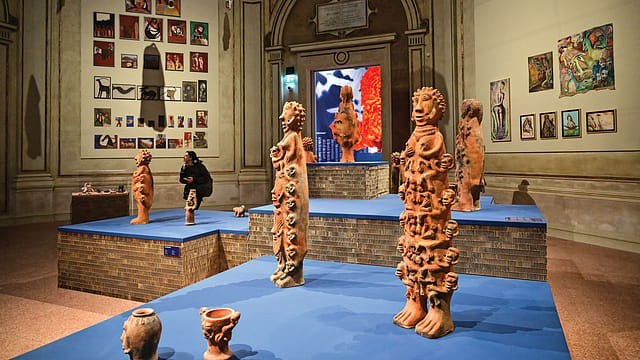
A similar resonance emerged in the work of the late Senegalese ceramic sculptor Seyni Awa Camara. Her clay figures, populated by spirits, animals and mythological presences, felt surprisingly familiar. Encountering them, I found myself thinking of terracotta traditions across Bengal, rural clay votive figures, tribal sculptural practices and the many animist cosmologies that continue to shape Adivasi and indigenous communities across South Asia specially Jharkhand, Odissa, Chattisgarh and many parts of the North East like Arunachal Pradesh and Manipur in India. Though separated by geography, these practices often share a refusal of rigid distinctions between human and non-human worlds.
Another striking example was the work of Leonilda González, whose woodcut prints appeared within the exhibition's broader emphasis on handmaking and graphic traditions. Her Novias revolucionarias (Revolutionary Brides) series combines irony, humour and anger to depict brides resisting the structures that seek to contain them. Originally conceived as a feminist critique of patriarchy, the prints later came to be read as symbols of resistance to Uruguay's military dictatorship. González's work embodies one of the central lessons of In Minor Keys: meanings are never fixed. Images, like songs and myths, continue to gather new frequencies as they move through history. The hand, in Kouoh's Biennale, is never separated from politics.
While the curation definitely foregrounds artists from Africa, Asia, Latin America, Indigenous communities, and the diaspora, one of its quieter achievements is the way it reorients our understanding of artists working within Western contexts as well. The exhibition does not simply invert existing hierarchies; it proposes different ways of seeing altogether.Among the works that lingered most unexpectedly in my mind was American photographer & film artist Carrie Schneider's First Living Woman (2026), a voluminous one-kilometre-long chromogenic photograph unfurled through the Arsenale. Drawing upon an eight-second cinematic fragment from Chris Marker's La Jetée, Schneider painstakingly reanimates the film's only moving image: a woman's face suspended between sleep and wakefulness. In an era defined by the accelerated circulation and consumption of images, the work proposes memory as something slower, embodied and almost devotional.Schneider's monumental gesture enacts a politics of attention remarkably close to Kouoh's own curatorial vision. The work asks viewers to dwell with a fleeting image for an almost impossible duration, transforming an instant into an act of sustained looking. The result is a work that feels less concerned with representation than with perception itself, reminding us that resistance can sometimes begin with the simple act of learning how to look differently.
If Schneider slows the image almost to stillness, Indian writer & artist Himali Singh Soin along with performance artist David Soin Tappeser approach memory through speculative technologies and imagined futures. Their work engages extraction, ecology and myth through a more mediated visual language. While I found myself less emotionally drawn to it than some of the exhibition's more tactile or embodied works, its presence nonetheless expanded Kouoh's understanding of how alternative histories might be narrated.
What In Minor Keys ultimately accomplishes is something many curators, artists and scholars from the Global South have been attempting for decades: rather than positioning artists from Africa, Asia, Latin America, Indigenous communities and the diaspora as supplements to an already established canon, Kouoh reorganises the terms of the conversation itself. Some critics have argued that the exhibition risks exoticising artists from the Global South by foregrounding craft, ritual, spirituality, myth and forms of making often excluded from dominant contemporary art discourse. Yet this reading misunderstands the sophistication of Kouoh's curatorial framework. These works are never presented as ethnographic curiosities, survivals of tradition, or alternatives to contemporary art. Rather, they emerge as intellectual, aesthetic and philosophical systems in their own right. What distinguishes In Minor Keys is Kouoh's profound understanding of multiple artistic genealogies. The exhibition refuses the hierarchy that places Western modernity at the centre and everything else at its margins. Instead, artists move through overlapping histories of making, believing, remembering and world-building that are every bit as complex, contemporary and theoretically rigorous as the traditions that have long dominated art history.
● If the garden became a threshold between visible and invisible worlds, poetry offered another language through which these continuities could be expressed. In her curatorial statement, Kouoh writes that while minor keys are often associated with melancholy and estrangement, they also contain "cadences, melodies and silences of resonant worlds" capable of gathering people together across division and conflict. The exhibition repeatedly returns to language not as explanation but as a form of listening. This sensibility is echoed by Biennale President Pietrangelo Buttafuoco, who describes Kouoh's vision as the creation of "a listening zone tuned into a lower frequency." Elsewhere, he invokes a procession of poets, writing that humanity moves through the exhibition as "the tree, the root, the seed... the forest on the move with Koyo." Poetry and gardens become intertwined methodologies, both concerned with cultivation, relation and forms of knowledge that unfold slowly over time.
One of the most moving articulations of this appears in María Magdalena Campos-Pons' Anatomy of the Magnolia Tree for Koyo Kouoh and Toni Morrison. Through monumental portraits, sculptural magnolia forms and an immersive soundscape, Campos-Pons brings two extraordinary world-makers into conversation. Morrison, who illuminated the interior lives of Black women through literature is linked with Kouoh, who cultivated space for artists from the Global South through curatorial practice, by a shared attentiveness to what lies beneath dominant narratives.
Kouoh herself invokes Toni Morrison's observation: "In our myths, in our songs, that's where the seeds are. It is not possible to constantly hone in on the crisis. You have to have the love and you have to have the magic, that's also life."
Perhaps nowhere is this clearer than at the beginning of the Arsenale, where visitors encounter Palestinian poet Refaat Alareer'sIf I Must Die. Written shortly before his death in Gaza, the poem imagines storytelling itself as an act of survival and continuity. Its appearance feels especially poignant given Palestine's absence from the architecture of the national pavilions. Here, poetry accomplishes what geopolitics often cannot. It creates a space of presence where official structures have produced absence. I found the encounter unexpectedly overwhelming. Moving through Venice with questions of inheritance and continuity already close to the surface, Alareer's poem struck with particular force. It is ultimately a meditation on what remains after a life ends: not monuments or institutions, but stories carried forward by others. It is difficult not to read it, too, through the lens of Kouoh's own posthumous Biennale. Again and again, In Minor Keys returns to the possibility that what survives us: stories, songs, myths, memories and acts of care, may ultimately matter more than the institutions that contain them.
Curiously, nearby were posters announcing Pussy Riot's intervention at the Biennale. The juxtaposition felt both incongruous and perfectly apt. On one side was a poem rooted in mourning, memory and hope; on the other, a call to direct political action. One through protest, the other through poetry. One through confrontation, the other through reflection. In that moment, I found myself returning to Morrison's words: "It is not possible to constantly hone in on the crisis." Neither Alareer nor Pussy Riot turns away from crisis, but they approach it through different registers. One insists on urgency; the other creates space for mourning, memory and the possibility of carrying something forward.
This, perhaps, is one of the most profound achievements of In Minor Keys. The exhibition never asks us to choose between these positions. It acknowledges the necessity of protest while also making room for the slower work of healing, storytelling and repair. All of its recurring motifs: gardens, poems, handmaking, spirits, ancestors and afterlives ultimately return to the same question: what survives?
Part 3. Nations in a Minor Key
If the garden is a practice of proliferation, the pavilion is a technology of borders, this tension lies at the heart of Venice itself. The central exhibition repeatedly asks visitors to inhabit ambiguity, relation and the spaces between fixed identities. The national pavilions, by contrast, remain rooted in the nineteenth-century logic of representation, requiring artists to stand in for nations at a moment when migration, diaspora and transnational belonging increasingly complicate such categories. If Kouoh's exhibition challenged fixed identities, many of the strongest national pavilions seemed engaged in a similar conversation.
● One of the most compelling figures linking Koyo Kouoh's central exhibition and the national pavilions was Khaled Sabsabi. Earlier this year, Sabsabi found himself at the centre of a heated debate after being removed as Australia's representative to the Venice Biennale following political controversy surrounding earlier works. The decision prompted widespread criticism from artists, curators and members of the selection committee, ultimately leading to his reinstatement. By the time Venice opened, Sabsabi's participation had become emblematic of many of the broader questions circulating throughout the Biennale: who gets to represent a nation, how institutions respond to political pressure and whether complexity can survive an increasingly polarized public sphere. In the Arsenale, his immersive installation khalil unfolded through projected imagery, sound, scent and light, creating a contemplative environment that connected migration, spirituality and shared humanity. Rooted in Sufi philosophies and shaped by Sabsabi's own experience of displacement, the work connected reality with the metaphysical, embracing flux rather than certainty. His Australian Pavilion presentation, conference of oneself, extended many of these concerns through painting, projection and sound. Together, the two works felt like parallel meditations on belonging, demonstrating how identities are formed not through fixed categories but through continuous processes of encounter and transformation. Sabsabi's presence in both the central exhibition and a national pavilion offered a useful reminder that, despite their institutional separation, many of the strongest pavilions seemed to be grappling with concerns remarkably close to those animating In Minor Keys.
● The pavilion I anticipated most, however, was India's.
India returned to Venice with Home: Geographies of Distance, curated by Amin Jaffer and bringing together Alwar Balasubramaniam, Sumakshi Singh, Ranjani Shettar, Asim Waqif and Skarma Sonam Tashi. The pavilion immediately impressed through the confidence of its presentation. The scale was ambitious, the installation elegantly resolved, and the lighting among the most sophisticated I encountered in Venice. There was a palpable sense of care in the execution and an undeniable refinement in its aesthetic language. At a purely exhibition-making level, it was one of the most polished national presentations in Venice. Several individual works lingered in the mind long after leaving the pavilion. For me, Sumakshi Singh's work was among its most compelling contributions. Through a sensitive orchestration of scale, material and spatial experience, she approached home not as a theme to be illustrated but as something fragile, elusive and deeply felt. Her installation understood memory as something partial and unstable, allowing absence and presence to coexist without forcing resolution. In doing so, it came closest to the spirit of In Minor Keys itself. Equally memorable was Asim Waqif's installation. Working with bamboo, a material simultaneously invasive, vernacular, architectural and deeply embedded within both rural and urban building traditions, he created an environment that encouraged occupation rather than observation. Hollow bamboo seating structures allowed visitors to sit within the work itself, experiencing it from the inside out. Particularly effective was the way the installation extended vertically into the pavilion's upper level, creating a dialogue with Skarma Sonam Tashi's work above. The piece demonstrated how familiar materials can become sites of imagination, habitation and encounter. The work also reminded me of one of the strongest experiences elsewhere in Venice: Morocco's debut national pavilion that had an equally tactile feel. Ranjani Shettar's installation was undeniably beautiful. One could clearly see the artist's longstanding engagement with ornament, organic forms and material sensitivity. Yet for me the work remained somewhat too decorative, its extraordinary formal elegance not always matched by a corresponding depth of metaphor. I found myself wanting it to move beyond beauty toward a more expansive conceptual register. Similarly, while I have long admired Alwar Balasubramaniam's ability to transform ordinary materials into meditations on absence, perception and time, his contribution felt more literal than some of his earlier and more open-ended works. Sonam Tashi Skarma’s work in the past has been fantastic in the small-scale cardboard landscapes that he made evoking both the fragility of Ladakh and foregrounding the sustainability crisis around the increasing tourist interest that has abounded in the region. However, this particular commissioned work for the pavilion did not evoke the same, instead felt forced to comply with the scale of the other works around. Wish the curator had had more of a history with the artists to be able to help direct their work that was closer to their own vision.
Taken together, the pavilion demonstrated considerable ambition. The sophistication of its presentation, the sensitivity of its installation design and the quality of the participating artists all made for a compelling return to Venice. Yet the exhibition also revealed what felt like a missed opportunity.
What I found most surprising was the relative absence of any sustained engagement with South Asia's extraordinary histories of making or the aesthetics specific to it. Throughout In Minor Keys, Kouoh repeatedly foregrounded craft, tribal and animist art, material knowledge and inherited artistic traditions as sophisticated forms of intellectual inquiry. Against this backdrop, India's presentation occasionally felt detached from some of the very histories it was uniquely positioned to illuminate. What made this absence particularly noticeable was that many of the strongest presentations across Venice derived their power precisely from the opposite impulse. Whether in Morocco's engagement with weaving traditions, Faig Ahmed's reimagining of carpet-making in Azerbaijan, or the numerous artists throughout Kouoh's curation who drew unapologetically from vernacular, spiritual and craft-based lineages; these works did not shy away from the aesthetic histories of their regions. Instead, they treated them as living intellectual traditions capable of generating contemporary forms and ideas.
For many international visitors unfamiliar with the Indian subcontinent's artistic genealogies, Venice offered a rare opportunity to encounter those histories anew. The India Pavilion instead often operated within only a familiar Western contemporary art vocabulary, privileging material experimentation without always excavating the deeper cultural lineages from which those materials emerge. For a pavilion titled Home: Geographies of Distance, I also expected a deeper engagement with migration, displacement, diaspora and postcolonial mobility. These concerns surfaced intermittently but rarely became the central framework through which the exhibition was understood. Home often remained elegiac rather than fully interrogated. Here too, one sensed a missed opportunity to expand the conversation beyond geography toward the more layered realities of movement, memory and belonging that have shaped modern South Asian experience.
Ultimately, I left the India Pavilion with a sense of admiration as well as wistfulness at the loss of possibility. Its return to Venice is important and welcome. The pavilion demonstrated confidence, sophistication and ambition. Yet at a Biennale so invested in recovering overlooked histories, material genealogies and alternative ways of knowing, one could not help but imagine how much more expansive the conversation around home might have become.
● The Japanese Pavilion lingered in my mind for its unexpected tenderness. Created by queer artist Ei Arakawa-Nash, Grass Babies, Moon Babies transformed caregiving into an artistic methodology. Visitors were invited to carry and care for baby dolls distributed throughout the pavilion, turning spectatorship itself into an act of responsibility. What made the installation particularly moving was the way each child seemed to carry the shadow of catastrophe. The babies evoked the long afterlives of war, disaster, displacement and collective trauma that have shaped modern Japanese history. In some ways, the work posed a quietly devastating question: what does it mean to bring a child into a world that appears committed to reproducing civilisational trauma on an endless loop? Yet Arakawa-Nash ultimately refused despair. The installation remained grounded in the belief that hope itself is a form of action. At the same time, it never lost sight of the inherited violence passed between generations. In a Biennale preoccupied with continuity and afterlife, the pavilion became a meditation not only on what we pass on to the future, but also on what the future inherits from us.
● Morocco's national pavilion was one of the most assured and stunning pavilions I encountered.It was a historic debut at this year’s biennale with Asǝṭṭa (the Amazigh "ritual of weaving"), a monumental 300-square-meter site-specific installation conceived by Marrakech-based architect-turned-artist Amina Agueznay and curated by Meriem Berrada. Aligned with the Biennale’s wider focus, this project elevated humble craftsmanship to high art by celebrating invisible labour and collective memory. Agueznay partnered with a collective of 166 traditional, mostly female artisans to create an immersive, porous "second skin" or membrane transforming the brick interior of the Artiglierie. The work boasted a massive materiality, composed of over 200 giant woven panels of naturally dyed wool from the Tiflet region, seamlessly blending weaving with basketry, embroidery, metal-smithing and traditional mozone (silver sequins) that poetically connect the Middle Atlas Mountains to Venice's canals. At the center of this vertical environment lay a monumental bed of sand covered by a woven structure representing the physical Moroccan landscape, the horizontal vastness of the desert and the "birth" of the loom as a living organism. Crucially, this central foundation functioned as a gelsa—a traditional Moroccan space for gathering and sitting where visitors were seen resting, sitting and reclining, perfectly capturing the ancestral spirit of communal connection. While filtered light softly washed across their bodies. The installation offered something increasingly rare in exhibitions: spaces of rest, immersion and tactile encounter.
● The Nordic Pavilion, representing Sweden, Finland and Norway, was also among the most visually striking presentations I saw. Curated by Anna Mustonen and bringing together Klara Kristalova, Benjamin Orlow and Tori Wrånes, How Many Angels Can Dance on the Head of a Pin? transformed the pavilion into a mythical landscape populated by oversized sculptural presences, hybrid beings and dreamlike forms that seemed to exist somewhere between folklore, fairytale and hallucination. Kristalova's monumental ceramic figures, with their strange vulnerability and psychological depth, felt as though they had wandered out of a Nordic fable. Orlow's sculptural environments and Wrånes' immersive interventions created a world in which architecture, body, myth and memory continually bled into one another. Rather than presenting mythology as something belonging to the past, the pavilion treated it as a living language through which contemporary anxieties around transformation, collapse, renewal and belonging could still be articulated. What stayed with me most was the pavilion's embrace of imagination as a form of knowledge. Much like the strongest works in Kouoh's exhibition, it resisted the pressure to explain itself through rational or documentary terms. Instead, it trusted myth, atmosphere and the uncanny. In doing so, it reminded visitors that stories, spirits and speculative worlds remain powerful tools for understanding the present even in the Western world.
● Greeting visitors just outside the Arsenale were the National pavilions of Hong Kong (Fermata) and Azerbaijan next to each other. The Hong Kong presentation, Fermata, possessed a quiet atmospheric and ambient beauty. Through delicate interventions of light, sound and movement, Kingsley Ng and Angel Hui transformed ordinary experiences of urban life into a meditation on pause, duration and attention; an exhibition that seemed perfectly attuned to the slower frequencies of In Minor Keys.
Yet it was Azerbaijan's pavilion, featuring Faig Ahmed, which completely took me by surprise. Ahmed has long been celebrated for reimagining the visual language of the carpet, but here he pushed the conversation even further. Alongside transformed textiles that seemed to unravel, distort and spill into new dimensions, the pavilion incorporated sophisticated AI-generated elements that merged mythology, astrology, technology and craft into speculative visions of the future. What remained with me most, however, was Ahmed's extraordinary use of colour. His carpets seemed to exist in a state of metamorphosis. Traditional motifs appeared to melt, moult and flow across the surface, transforming into something fluid, almost biological. Woven pattern gave way to abstraction and then returned again, creating works that were at once deeply rooted in tradition and startlingly contemporary. The effect was mesmerising: a visual language in which the handmade, the digital, the ancestral and the futuristic coexisted within the same frame. Rather than positioning tradition and innovation as opposing forces, Ahmed demonstrated how inherited forms of knowledge can become tools for imagining entirely new worlds. What made the pavilion so compelling was its refusal to choose between the handmade and the technological. The centuries-old craft of carpet making existed alongside artificial intelligence, cosmological narratives and futuristic environments. The result was neither nostalgic nor technophilic. Instead, Ahmed offered a model for how regional aesthetic traditions can remain alive precisely because they continue to evolve.
● The Malta Pavilion operated in a very different register. Combining moving image, digital interventions and immersive sound, it created a cinematic environment that embraced ambiguity rather than certainty. The digital and scenographic elements were particularly compelling, producing an experience that unfolded through atmosphere rather than narrative and inviting viewers to inhabit uncertainty rather than resolve it.
● Not every pavilion achieved the same level of resonance. Saudi Arabia's presentation, despite the immense institutional and financial resources supporting it, left me surprisingly underwhelmed. The work was impeccably produced, yet lacked the urgency, specificity and cultural confidence that animated many of the stronger presentations elsewhere. At a Biennale so invested in questions of memory, inheritance, and alternative forms of knowledge, the pavilion's considerable resources never quite translated into an equally compelling intellectual proposition.
● Located away from the main arteries of the Biennale, the Pakistan Pavilion was housed in an intimate palazzo alongside the neighbouring Bahamas Pavilion. Removed from the crowds of the Giardini and Arsenale, the setting felt unusually contemplative, inviting a slower and more attentive form of viewing. It was perhaps fitting that two of the presentations I found most compelling on questions of colonial inheritance occupied this quieter corner of Venice.
The Pakistan Pavilion was deeply affecting. In Punj•ab- A Sublime Terrain, Faiza Butt and curator Beatriz Cifuentes Feliciano treated Punjab not as a territory divided by borders but as a shared cultural landscape. Moving across painting, textiles, ceramics and photography, the pavilion traced the cultural afterlives of Partition. I found particularly moving the exhibition’s attention to the lives of materials and the people who work with them. Rather than treating craft as heritage, Butt approached it as something living and continually remade. The exhibition's emphasis on collective production and collaboration with women artisans was particularly powerful, foregrounding making itself as a repository of cultural memory and shared authorship. Equally compelling was the pavilion's documentary component, which traced the rapid mechanisation of the subcontinent's handmade textile industries and reflected on how memory and labour intersect with global systems of extraction. Watching generations of artisanal knowledge give way to industrial production, I was reminded how familiar this story remains across South Asia, from Bangladesh to India and Sri Lanka, where textile production increasingly operates within global systems of outsourcing a. Here, memory becomes inseparable from economics. The pavilion transformed Punjab into a lens through which to examine labour, colonial histories, Partition and the ongoing reshaping of cultural production under global capitalism.
Next door, the Bahamas Pavilion approached colonial inheritance through a different register. Where Pakistan's presentation was rooted in material histories of making and the long shadow of Partition, the Bahamas turned its attention toward the afterlives of empire, cultural resilience and the ongoing work of self-definition in societies still negotiating colonial legacies. The work felt less concerned with borders than with memory itself, how histories of extraction, migration and displacement continue to shape contemporary identities across island nations and the wider Global South. Artists John Beadle and Lavar Munroe explored migration and postcolonial repercussions using every day often discarded materials. Beadle’s seven-foot cardboard rudder, separated from any vessel, symbolised movement suspended, evoking bodies treated as cargo during transatlantic slavery. Munroe also used cardboard to reflect on crossing geographic, ancestral and spiritual boundaries.
While Pakistan grounded its narrative in labour and landscape, the Bahamas turned toward the ongoing work of identity formation in the wake of colonial histories. Seen together, the two pavilions created an unexpectedly productive conversation. One looked toward the rivers, textiles and shared cultural landscapes of Punjab; the other toward the archipelago, the sea and the lingering afterlives of empire. Yet both ultimately grappled with remarkably similar questions: how communities remember, how histories endure and how cultural identities survive the ruptures of colonialism. Together, they suggested another geography of connection, one organised less by nation-states than by shared experiences of displacement, extraction, resilience and survival across the Global South.
● Austria's pavilion offered a radically different register. Florentina Holzinger's immersive environment of bodies, water, performance and physical endurance was visceral, excessive and impossible to ignore. If Kouoh's exhibition often operated through subtle frequencies, Austria functioned as a kind of counterpoint, loud, corporeal and unapologetically confrontational.
● And then there was the Russian Pavilion. By the time I encountered it, it could only be viewed from the outside. Following protests earlier in the Biennale, the building had itself become a symbol of absence. Its architecture remained, but its intended function had been suspended. In a Biennale so concerned with visibility and erasure, the closed structure felt strangely eloquent.
Taken together, these pavilions revealed that even without a shared curatorial mandate, many were grappling with remarkably similar questions: migration, memory, craft, belonging, inheritance and survival. If Kouoh's central exhibition asked us to listen to quieter frequencies, the strongest national pavilions seemed to be doing much the same each in their own key.