Being Amazed by Kochi-Muziris Biennale
BAZAAR ROAD, Kochi’s trade spine since the 14th century, is lined with tea merchants and spice traders, smelling not of the cardamom and pepper that appear on postcards of Kerala, but of coriander, ground and sold by the sack. Freight trucks periodically choke the street. At tiny stalls, men stir kettles with the unhurried authority of those who have always known where trade settles. Kartika mangoes still hang on the trees, yellowing above the street, out of season yet stubborn. This is Mattancherry—older than the Kochi-Muziris Biennale, older even than the idea of the city—shaped by Arab traders, the Portuguese, the Dutch, the British and by a port economy that never fully left. This year, for the first time, the Biennale, in its sixth edition, has followed that history outward, no longer contained within Fort Kochi’s familiar circuit, but allowing the festival to spill into Mattancherry’s working streets—and even on to Willingdon Island—threading itself through shops, warehouses, cafés and lives already in motion.
At the Students’ Biennale at VKL Warehouse, as many as 160 colleges are participating in the effort. A wall carries the memories of children of the water— students who grew up around the sea, who speak of being ridiculed in school for smelling like fish. They answer that memory literally, pasting dried fish onto the wall, refusing metaphor, refusing sanitisation. On another wall, Diya Marie’s 150 sketches of women in pause—on local trains in Mumbai, at their homes in Roorkee—do not ask to be read as portraits so much as intervals, moments where nothing is being performed for anyone else. Elsewhere, a face assembles itself from planes and pins, a geometry of surveillance: biometric grids, call records, GPS logs, predictive policing labels converging into a mask that is both human and administrative. The Biennale, in this stretch, feels less like a curated statement than a temporary commons.
The sixth Kochi-Muziris Biennale arrives at a moment when large exhibitions across the world are under pressure to justify their scale. Budgets are tighter, shipping is costlier, and audiences are less patient with spectacle for its own sake. Against that backdrop, the edition themed ‘For The Time Being’, curated by artist and performer Nikhil Chopra, unfolds across 30 or so venues, with a marked emphasis on performance, durational work, and practices that rely on local fabrication. Spread across warehouses, godowns, and heritage structures in Fort Kochi, Willingdon Island, Mattancherry and the mainland, the Biennale resists a single centre of gravity. Instead, it moves laterally through the city, drawing attention to its working infrastructures. The selection is intensely material: glass, nets, soil, laterite, jute, scrap metal, e-waste, rammed earth, plants, screens—a pivot away from screen-smooth contemporary art toward matter that resists.
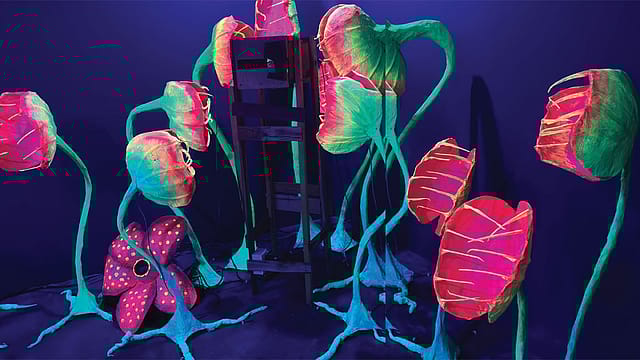
Artist selection, Chopra tells me, was intuitive yet rigorously ethical, balancing Indian and international practitioners, foregrounding emerging voices, women, queer and non-binary artists, and practices rooted in lived, durational engagement. He emphasises a deliberate flattening of hierarchy—spatial, symbolic and institutional—allowing emerging artists to occupy central positions while established figures framed and supported the experience. At Aspinwall House, which until last year used to be the beating heart of the Biennale, Birender Yadav’s massive work Only the Earth Knows Their Labour gets centrestage as it reconstructs the architecture of a brick kiln without its workers. Palm prints, terracotta casts of tools, and dispersed fragments stand in for bodies that have moved on, drawing attention to seasonal labour and its erasure. Nearby, under a saturated blue wash, a field of plant-forms rises from the floor—tall, attenuated stems that bend, their roots splayed wide, gripping the ground for balance. Each form carries a fleshy, folded head, glowing in bruised reds and greens. They are at once botanical and bodily: carnivorous flowers, organs lifted from anatomy. Dhiraj Rabha’s The Quiet Weight of Shadows documents the history of insurgency and surveillance in Assam through this eerie installation, along with archival material and video conversations with former ULFA members. The work resists closure, presenting memory as layered, contradictory and unfinished. “We were also trying to place artists who placed poetics before their politics,” says Chopra.

One of the Biennale’s unsaid urgencies lies in recognising Indian artists who had never previously entered an international exhibition circuit. “A lot of the Indian artists had never had the opportunity to exhibit in an international exhibition,” Chopra says, describing studio visits across Vadodara, Santiniketan, Kolkata and elsewhere that revealed “very astute talent.” The Biennale, in this sense, becomes a mechanism through which visibility, confidence and voice are redistributed—allowing emerging artists to occupy space on equal footing, to experience “their moment in the sun”.
ANOTHER MARKED shift this year is the prominence of performance. Artists such as Tino Sehgal, Pallavi Paul and Mandeep Raikhy foreground live, time-bound encounters. Sehgal’s work unfolds through conversation and gesture, leaving no physical residue. Paul’s sound-based practice bleeds across architectural boundaries, collapsing distinctions between rooms. Raikhy’s Hallucinations of an Artifact brings the Indus Valley’s ancient Dancing Girl to life through performance, using the iconic figurine’s posture as a point of departure to question the assumptions that have been heaped onto her over centuries. Three performers echo and disrupt her pose, even as the Mohenjo-daro Dancing Girl is continuously morphed by AI, on a screen behind them, into new postures, tilted, stretched, destabilised, her iconic stance loosened from archaeological certainty.
Material labour is a recurring thread. Ghanaian artist Ibrahim Mahama’s installation, Parliament of Ghosts, uses stitched jute sacks—objects embedded in global trade routes and histories of extraction—to transform the space into an environment shaped by accumulation and use. “Calling up my friends like Mahama, Dineo Seshee Bopape, Otobong Nkanga, Adrián Villar Rojas and Maria Hassabi was as simple as picking up the phone and setting up a WhatsApp call, because we’ve crossed paths for years at dinner tables, installations and artist gatherings,” says Chopra. “It was a resounding yes from every artist we spoke to, which is where this idea of friendship ecologies comes from—you don’t need to be flying across the world to make these connections.”
For Bose Krishnamachari, founder-president of the Kochi Biennale Foundation, what distinguishes this edition is not simply its scale but its method. He describes ‘For the Time Being’ as a project shaped by process rather than pre-definition—one that unfolds through on-site making, workshops and forms of collaboration that resist easy prediction. It was this aspect, he says, that made Chopra’s curatorial proposal compelling: the idea that the Biennale would emerge through listening, labour and time, rather than arrive fully formed. Managing such a project, he admits, involves a degree of chaos, negotiated carefully through close collaboration with labour unions and local systems. Out of that disorder, he says, something durable takes shape. “The Biennale is temporary, but its impact is not. Its temporality carries a longer, more sustained effect,” says Krishnamachari. “What matters to me is that people, especially students, get the chance to encounter great artists in their own city. That opportunity changes how you think.”
At the edge of the harbour, where boats bob in blues and reds against the industrial horizon, Armaan Collective, a cafe space in the making, opens its doors with Edam, a parallel exhibition featuring Kerala artists, with some of the Biennale’s oldest patrons gathered to support them. In one room, black-and-white photographs of ship breaking yards in Gujarat by Madhu Kapparath, previously unpublished, show steel giants reduced to skeleton and labour. Men walk across wreckage like ancestors of industry, debris weighing down the frame. The photographs feel like testimony, against the white walls. Across the room, dark, root-like lines rise from a compacted base, branching upward as if caught mid-emergence. They appear at once as plant matter and a snapshot of the mind. Shadiya CK works with plants, cloth, and stone as if they were extensions of the body, drawing on her herbarium in Kannur to make images suffused with decay and memory. In the next room is an equally striking work— a deep red rug featuring two black-clad Muslim women with Theyyam masks, painted by twin Muslim artists, Asna and Thasni MA. Edam allows the Biennale to inhabit a threshold between community and institution, between archive and lived experience.
ELSEWHERE IN THE Biennale, Ibrahim Mahama transforms a hall at Anand Warehouse, an aging relic of Mattancherry’s mercantile past, with towering walls of stitched jute sacks, arranging salvaged wooden chairs into a stepped arena for gathering, listening and collective presence. The sacks, sourced locally and bearing the stains, stamps and scars of trade, form a dense architectural skin that carries with it the histories of labour, circulation and extraction embedded in everyday materials. Within this enclosure, the work functions as a civic instrument: a place designed to be occupied, not observed, where visitors are invited to sit, wait and speak. Mahama has been in Kochi for weeks overseeing the project. “When you work with certain materials, embedded within them are all these questions— historical, political, economic. Some artists try to ignore that and focus only on aesthetics. But for me, even that choice is already a political position,” he tells me. “The moment you decide to work with a material in its raw state, with its real value intact, you open up wounds in history. And for those of us coming from the Global South, there is no luxury of pretending otherwise. There is no point in making a beautiful painting or sculpture just for the sake of beauty. The world we live in is crumbling. It’s falling apart. So the work has to do more than exist as form.”
In a back room at a decaying warehouse, Niroj Satpathy’s massive installation confronts the visitor as a hoard— shelves rising to the rafters, packed tight with dolls, clocks, cameras, glass bottles, broken electronics, tools, figurines, religious objects and nameless debris. Nothing is placed for elegance. Everything is placed because it has survived being thrown away. Satpathy comes to this accumulation from lived proximity. For five years, he worked as a night supervisor with Delhi’s Solid Waste Management Department, moving through landfills that function as both habitat and archive. What he brings into the Biennale is not an abstract critique of waste but its afterlife: objects already stripped of use-value, reorganised into a fragile order that mirrors how cities themselves function—through segregation, stacking, concealment.
Chopra says Satpathy “blew my mind” when he first encountered the work online, adding that after reading about his trajectory he was “literally on a plane the next day to go and see him”. What struck him most was the durational intensity of Satpathy’s engagement: “You spent five years on the garbage dump in Okhla—that’s performance art, that’s endurance.”
Several of the sculptural figures embedded within Satpathy’s Dhalan verge on the grotesque: hybrid bodies assembled from refuse, wires, fabric and taxidermic remnants. One holds a megaphone where a face should be. Another appears armed, militarised, rising. These are not characters so much as functions—power, surveillance, authority—built from the very detritus those systems generate. Small cameras appear throughout the work. They may or may not function. The point, Satpathy says, is that the presence of the camera is enough. Surveillance no longer needs to be operational to be effective. Consciousness adjusts itself in advance. The work was assembled in seven days with volunteer help, but it carries years of accumulation within it. It feels provisional, overfull, on the brink of collapse. That instability is its ethic. Dhalan is about what remains when consumption outruns care, when surveillance replaces responsibility, and when waste becomes the most honest record a city keeps of itself.
WORKS LIKE DHALAN need room to breathe—not just physical space, but time, weight and the ability to unfold without being contained. Chopra describes the Island Warehouse at Willingdon as an outcome of necessity that gradually turned into the Biennale’s most generative space. What began as a response to the loss of space at Aspinwall House became, in his words, “a real game changer”, a place where the exhibition could think at scale. Crossing the river to Willingdon Island allowed the Biennale to loosen its grip on inherited hierarchies and to conceive of a single, vast space as a continuous experience rather than a sequence of discrete displays. Within the warehouse, placement became a form of choreography. Chopra talks about how established artists were used to “bracket the exhibition”, with Dineo Seshee Bopape positioned at the beginning and Maria Hassabi at the end, while the expansive centre was given over to emerging voices. For Chopra, Kochi’s hospitality is historically embedded. He links it to the city’s mercantile past and to the ethos established by the Biennale’s founders, who made visitors “feel amazed when they came here”. Hosting, in this sense, is active participation, a willingness to absorb risk, improvisation, and last-minute chaos. The Biennale opened despite unfinished venues and compressed timelines, and Chopra reads it as the city stepping in: “Kochi took over this idea of hosting the Biennale.” The result was not perfection but momentum, a collective decision to open doors, receive people, and allow the exhibition to come into being in public.
(Kochi-Muziris Biennale is on view till March 31, 2026)