Kitchen Confidential: Filmmaker Farah Khan turns her lens on a star-studded culinary show whose real hero is her cook
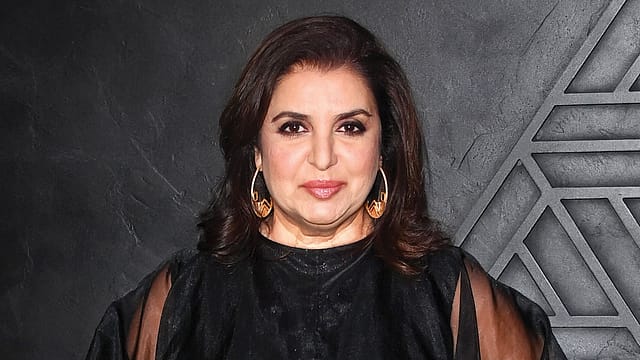
HEROINE KI ENTRY” is a very Bollywood-esque expression— the exact moment when the hero (and the audience) in a film falls for the lead actress, as she makes a dramatic entry on screen for the first time. The impact is amplified by slow-motion, a wind machine lifting her hair, a drifting pallu and a background score that builds until the camera pans on the star-making shot.
A self-confessed Bollywood aficionado, award-winning choreographer and filmmaker Farah Khan, for over three decades, has aced that moment—whether it is Sushmita Sen’s Ms Chandni gliding onto the college campus in Main Hoon Na (2004) or Deepika Padukone stepping out of her vintage car as Shanti Priya in Om Shanti Om (2007).
Khan knows how to make actors own the scene—like a spectacle, with calculated precision. Which is why, it is almost comical to watch Khan’s stars falter when entering kitchens. Give them a gas stove, a spatula, an apron, some vegetables to dice, and the performance does not land quite like it does on the big screen. “But that precisely is the point,” says Khan. “There are no retakes. The chaos is not edited out.” It is the content.
Khan’s YouTube channel has amassed 2.8 million subscribers since early 2024. In her vlogs, she visits the homes of a diverse group of guests, cooks with them, goes on a home tour and ends with a shared meal. What separates Khan the choreographer from Khan the YouTuber, is that here she isn’t choreographing precision. Instead, she is celebrating the absence of it.
Take Shilpa Shetty, who has appeared on Khan’s vlog. They reminisce about her cameo in Om Shanti Om’s multi-starrer song, ‘Deewangi Deewangi’–a sequence so meticulously orchestrated and so closely controlled that Shetty had to return to set the next day because the filmmaker was not satisfied with the length of her sari.
But in Shetty’s kitchen, while cooking payasam, a traditional South Indian pudding, that sense of control unravels quickly. Cashews burn. The dish turns bitter. Shetty and her mother debate if it was the coconut milk that hampered the taste. Someone suggested reshooting it.
But Khan remains unfazed. She tastes it, shrugs and says almost gleefully, “It’s lovely. I love the burnt taste.” Shetty, horrified, asks if the confusion would be edited out. “Of course not,” Khan shoots back. “That is the main thing.”
And each episode carries this chaos. Ananya Panday cannot light a gas stove. Sonu Sood runs out of paneer. Nargis Fakhri casually confirms mid-cooking, “this is not a real recipe” to Khan’s bewilderment. Jackie Shroff lounges in a dip pool before demonstrating how he can chop onions without looking at them.
In the middle of all this stirring, grinding and seasoning is Dilip Mukhiya, Khan’s cook since 2012. He is never introduced as the “help”. The narrative simply allows him to exist.

Their banter—about Mukhiya’s need to have an AC in the kitchen, pay hike, his marriage—acts out as a subplot. “This is how I have been talking to him for 14 years. Nothing is scripted,” Khan says. Yet, the storytelling lands differently, not because of their dynamic—but because of its visibility.
Khan’s vlogs abandon a familiar manifesto—households crumble in the absence of help, yet they continue to remain invisible. In Khan’s vlogs, the camera is panned on him. “It was not supposed to be as radical as people make it seem,” Khan says. “But I am glad it is turning out to be something meaningful.”
Khan lets Mukhiya lead conversations, often without knowing who the guest is. His ignorance is not criticised, but is treated with jest, almost implying that fame isn’t universal. The stars aren’t offended either when he is confused if Shruti Haasan is the daughter of Rajinikanth or Kamal Haasan.
Long before YouTube, Khan had already set a precedent for democratic storytelling. She was one of the first filmmakers to feature every technician—spot boys, light-men, assistants—during her films’ end credits. Only this time, Dilip is not in the end credits. He is in the movie.
I HAVE BEEN A technician all my life. It was only after season one of Indian Idol [in which she was a judge] that I began to appear on screen,” Khan says. That shift made her realise why visibility matters.
As the channel grows, so does Mukhiya’s visibility. People recognise him. Guests cheer for him. They joke about poaching him. But what Khan finds interesting is what the fame signals.
He interrupts conversations. In one episode with Shabana Azmi and Javed Akhtar, he is seen mouthing “Irshad Irshad” mid-conversation. People in the comments section call it distracting. But this complaint is equally telling. The assumption that the spotlight should always be on the celebrity is immediately debunked. This subtle stance defines much of the narrative of Khan’s videos.
“I feel conversations around domestic help have changed,” she says. “They are our lifeline, and we cannot do without them. Then, why should we hesitate in making them seen?” Mukhiya’s narrative spills beyond the kitchen. Entire episodes follow him to his village, with one such episode amassing 10 million views. “Clearly, it resonated,” says Khan. Mukhiya’s story features on the channel now as a parallel storyline.
Guests now bring their cooks forward, says Khan. They are introduced on camera too. “I feel a sense of pride when they say, ‘This is our Dilip’,” she says. “I did not intend to create this domestic narrative, but I like this change.”
“It is also interesting now that even the staff of the guests are excited to be on camera,” says Khan, who now makes it a point to show up with gifts—not just for her celebrity guests, but also the domestic help. It is not an afterthought, but a template—with them expressing disbelief and gratitude on receiving watches, air fryers or designer bags.
In a few videos, there is a familiar sense of camaraderie, as cooks communicate in their local dialect—many from the same village in Bihar as Mukhiya. It is in these fleeting moments that their unspoken stories—of humble beginnings, migration and labour—begin to appear.
And yet, despite the adulation, there is a line that is never crossed. “I am not saying that every time there is a party, he sits and eats with us. He chooses to never cross a certain boundary,” Khan says. The hierarchy does not entirely disappear, but bends a little.
SHAH RUKH KHAN once joked about it on set, she recalls: the best thing about Khan is that she treats everyone equally—she talks badly to everyone. It was uttered in true SRK jest, but the flattening of the hierarchy has always been a part of her process. Bollywood stars, musicians, singers, politicians, Bigg Boss contestants, influencers, and even truck drivers all feature on the channel under the same format. One episode features a truck driver R Rajesh who cooks angara chicken in a makeshift garage, the ambience distant from celebrity kitchens. And in another, Khan walks the narrow streets of a Mumbai slum, stepping into the one-room home of viral sensation Shahida Ansari.
“I do not want to make it classist,” says Khan who insists that her guests do not show up with an elaborate entourage, and hair and makeup teams. “That is not the tonality of the show,” she quips.
What began as cooking in her own kitchen expanded accidentally, and she has producer Boney Kapoor to thank for that segue. “He finished preparing scrambled eggs in almost five minutes. Now what? We pivoted to a home tour, and that became the show’s new template,” Khan explains. She admits that she misses the earlier, simpler format with just her and Mukhiya cooking. “It could have led to fatigue eventually.” Today, the transition seems inevitable: part cooking show, part home tour and part social commentary.
YouTube also offered her a sense of autonomy. Having done enough television over the years, she fully understood the medium’s limitations—channels dictating who appears as guests, interfering with creative decisions and chasing algorithms over relevance. “My YouTube channel is entirely my own. There is no one overriding me,” Khan says, noticing how audiences were gravitating towards YouTube. At the time, she wasn’t directing any films, and the prospect of starting something new, felt promising.
It is almost ironic that her new innings echo a similar sentiment as Om Kapoor (played by SRK) from Om Shanti Om: “Picture abhi baaki hai, mere dost.” And all she needed was a kitchen, a camera and her cook.
Today, she isn’t looking back. Khan hopes to feature Salman Khan’s farmhouse. “But most audience requests are for Mannat—Shah Rukh Khan’s house. It is under renovation currently,” she says.
For a cooking show, Khan rarely dislikes anyone’s food and her comments are generally flattering. Guests are often curious to know whose cooking she didn’t enjoy. “I tell them—let me try yours first and then, I’ll tell you,” she laughs. Until then, with every bite, her verdict stays, “Too good!”