Divine Subversion
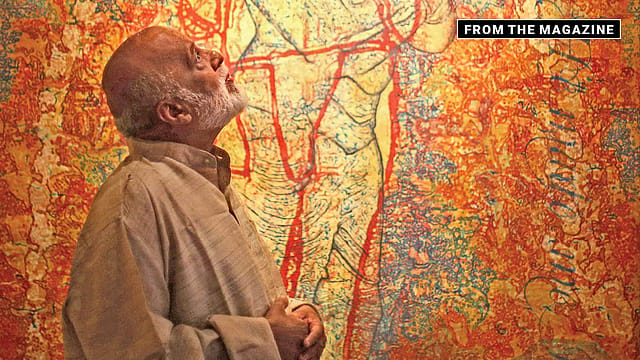
Like most of us, V Ramesh was raised on his grandmother’s stories. She narrated anecdotes from India’s mythological epics, with rich details and beautifully etched characters, to coax the child to eat. Unlike most of us, however, Ramesh continues to use these core memories as creative fodder decades later, resulting in larger-than-life, physically and metaphorically layered works of art.
The artist’s works, created over four decades across different mediums, are now the subject of the Sacred Spaces exhibition at Gallery Threshold in Delhi. Nearly a decade after his last solo presentation in the capital, this sweeping survey includes his figurative works from the 1980s to the early 1990s, capturing the fisherfolk of the Visakhapatnam coast, where he lives; paintings with allegorical references to spirituality and devotion which he has become largely known for; as well as a new body of work consisting of canvases and large-format watercolours. A monograph about Ramesh’s practice has also been released on the occasion.
“Ramesh occupies a singular position in Indian art,” says Tunty Chauhan, founder of Gallery Threshold. “Where much contemporary practice reaches for immediacy, his paintings withhold and unfold fresco-like canvases layered with fragments of cultural memory, traditional storytelling, and imagery from ancient manuscripts, none presented as direct citation, all dissolving into something felt before it is understood.” She describes this ambitious presentation of his work as “the chance to see, in one place, how a single sustained inquiry has deepened over a lifetime”.
Recently returned from Russia, where his paintings were shown at the State Hermitage Museum, St Petersburg, as part of Sediments of Becoming: Fossilised Present, Summoned Pasts—the first exhibition of contemporary Indian art in the institution’s 260-year history—Ramesh recalls a Russian connection with his love of art. “My father was an engineer who often travelled to Russia to study how steel was built. He would return with pictures and postcards from the Hermitage. These images fascinated me,” he shares. It’s also perhaps what set him on a creative path in life.
As a dutiful son, he initially chose to study for a BSc degree but soon realised it wasn’t for him, eventually making his way to Maharaja Sayajirao University (MSU) of Baroda in Vadodara. There, he studied under legendary names like Ghulammohammed Sheikh, Jyoti Bhatt and Ratan Parimoo. This switch was, according to him, the best decision he made. “There are times when things are not going well, or I’m feeling blue. That’s when I think of the moment when I decided that if I can just paint all my life, I will be the happiest person,” he says.
This conviction has translated over the years into many awards and recognitions. He was the first practising artist invited to put up a solo show at the National Gallery of Modern Art, Bengaluru, titled Remembrances of Voices Past, which later travelled to the American University Museum at the Katzen Arts Center in Washington DC. He received the Sanskriti Award in 1993 and both the Junior (1990-93) and Senior (1995-97) Fellowships of the Department of Culture, Government of India. In 1985, Ramesh also began teaching at the Andhra University, Visakhapatnam.
What sustained him through the years and his much-lauded practice was a single-minded reflection on the idea of devotion. He explains, “I wanted to find a language which no other contemporary painter had tackled. I found it in the idea of devotion. No one had done it in the allegorical way; it mostly remained literal illustration.” However, he never veered into religious territory.
“I like to tell stories. I like sharing with others, a sense of how I look at the world,” he adds. His series on medieval women poets is perhaps the best example of this. Ramesh discovered the Periya Puranam, a book of poetry, and was moved by the “emotional ecstasy that permeated their work” despite the immense gaps in time and geography. An account of the lives of 63 Shiva devotee-poets, this 12th century text is a repository of stories exploring ideas of faith, beliefs, devotion and violence. These devotees provided examples of deep faith, selflessness and spiritual attainment. However, it wasn’t till two decades later that he stumbled upon a century-old copy of the book with exquisite wood engravings that his interest was reignited, and he began recreating his versions of their stories in earnest.

Ramesh is equally drawn to Carnatic music. The exhibition’s launch was marked by a performance of verses evoking the sacred eroticism and intensity of Tamil bhakti by dancer Navtej Johar and vocalist Balakrishnan Raghav.
Mystic saints from the margins of established histories have become persistent muses for Ramesh. For instance, Karaikal Ammaiyar was one of the 63 Nayanmars who composed hymns in praise of Lord Shiva. She shunned her beauty to be able to worship without distraction, and therefore appears in a skeletal form in Ramesh’s paintings. Andal, from 8th-century Tamil Nadu, was the only female among the 12 Alvar saints who worshipped Lord Vishnu. Her connection to the Lord was expressed through a garland both in her story and in Ramesh’s art. Akka Mahadevi from 12th-century Karnataka is known as a feminist mystic who courageously left her home. Lal Ded from 14th-century Kashmir was chased out of her home by her mother-in-law and chose to traverse the world naked, singing divine truths.
Nandanar, a Dalit devotee who lived in the seventh century, was forbidden from entering the temple of Chidambaram but his pure devotion led to him merging with the space of worship. Kannappa—the brave tribal hunter and one of the Nayanars—plucked out his eyes and transplanted them on to a bleeding deity, as seen in Ramesh’s The Sight Giver (2024-25), while The Elephant Slayer (also 2024-25) draws from the tale of Eripathar’s killing of the royal elephant which had upset and overturned a devotee’s flower basket. A linguistic confusion resulted in the potter Neelakanta and his wife to lead celibate life till Shiva intervened and restored their lost youth—depicted in The Oath (2024-25). Each of these paintings uses a multitude of colours, as well as a variety of forms and text to evoke a sense of movement that goes beyond the physical.
Items of daily life also find a place in Ramesh’s art. One sees it in before-and-after scenes of a resplendent meal laid out on a banana leaf in Hence it is called food (2015) or leaves falling off a plinth in Fallen Warrior (2016). There are also his intriguing self-portraits in which he manages to convey more than meets the eye. In Self Portrait in the Studio with a Single Malt (2023), one sees the expression of joy in solitude, merriment in mere existence and pride in one’s vocation. As Chauhan says about the artist, “The most enduring artistic voices often emerge not from spectacle or urgency, but from patience, reflection and an unwavering devotion to the act of painting.”
A new body of watercolours displayed in a separate room at the show is also noteworthy. Ramesh admits to finding this medium intimidating owing to the lack of control one has over it. Yet he took on the challenge by painting on silk screen, which leaves in its wake only a faint stain of colour that is both luminous and arresting. Made as part of a series which shares its name with the exhibition, these new works depict symbols of sacrality. Broken garlands of tuberoses, prasadam on a banana leaf with each grain of rice on vivid display, brass deepams and other tools of worship, religious idols, and more, depict the artist’s intimate observations on the nature of devotion.
These new works, made in 2026, emerged from a conversation Ramesh had with an art critic who visited his home studio. When the latter remarked on the sacred feeling infused in his private space, Ramesh began to wonder how a space acquires sacrality. In response, he recreated the spiritual and cultural icons he has observed closely over the course of his lifetime.
While the thread of devotion ties together these varying bodies of work, Ramesh’s queries go beyond religious symbolism. He summarises what he feels about his work, and this show in particular, when he says, “Inspired by the poetry of Nandanar, there is a famous song in the text of Gopalkrishna (Bharati) that was subsequently sung by many legends of the Carnatic musical tradition such as MS Subbulakshmi, Sanjay Subrahmanyan and TM Krishna. The opening line of the song goes ‘Let me be in your presence’. It pretty much sums up what I wanted to say.”
Sacred Spaces is on view at CCA, Bikaner House, till October 17. The exhibition will continue at Gallery Threshold, New Delhi, till November 17