Book Clubs: Literary Company
FOR ALMOST TWO months now, I have struggled with Mario Vargas Llosa’s Aunt Julia And The Scriptwriter. The book, which is a thinly-disguised autobiographical novel about the two people who shaped Llosa’s early life as an aspiring writer—his aunt Julia, who, like the character in the book, he courted and married; and an eccentric scriptwriter for radio soap operas whom he knew—is anything but dull. And yet this entertaining screwball fantasy, in my hands, moved at the glacial pace of a book prescribed at school. Work and household chores intervened, and another form of text, one that announces its arrival with a bell and comes glowingly in our phones—telling us who liked whose photo or which account to follow—stole away whatever attention was left.
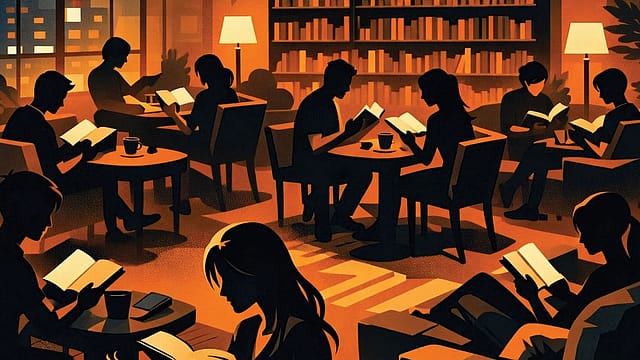
What I required, I realised, was to set aside some time, where no chore or phone notification could pull me away. And so, on a recent Sunday morning, carrying my Kindle under one arm, I elbowed my way through a crowd of aspiring marathon runners and elderly folks out for their morning walk in a park, and, squeezing myself into a gazebo at one end, powered on my Kindle. Around me, in the gazebo and under the shade of trees nearby, sat a group of silent readers, each engrossed in their books. If there were phone notifications or calls, none rang or were attended to. All of us simply sat in this idyll of silence, broken only by the occasional sound of a page being flipped.

Survival Instinct
22 May 2026 - Vol 04 | Issue 72
India navigates global economic turmoil with austerity and smart diplomacy
I had found my way into Powai Reads, one of the many silent reading groups that is taking over neighbourhood parks across the country. This group, like other silent reading groups, shows up every Sunday (some groups keep it on Saturdays). There is no membership or need for registration, not even a WhatsApp group. People who want to read simply show up on Sunday mornings, roll out a mat under a tree or find a bench, and read. Pleasantries, if exchanged, are reserved after the reading session.
I am among the last to arrive. Many others had been there for nearly two hours already. After another hour had passed, during which I had completed a substantial chunk of the book, I felt a gentle tap on my shoulder. The reading time was up. The books being read are stacked up for a photo, a tradition with this group, and after a brief exchange of pleasantries, a few move to a café, while the vast majority simply break away for their homes. It was a no-fuss book group, without any of the bells and whistles like discussions centred around a “book of the month” or commercial tie-ins that come with many book clubs today. Its only interest was in providing a space where people can read together for a few brief hours without any distraction. “Reading is such a solitary activity. What is great about a group like this is that it offers a sense of community,” Ananya Bhardwaj, the 27-year-old who started this group in 2023 after being inspired by another such group, Cubbon Reads in Bengaluru, tells me later. “Also, when somebody is going through a reading slump, being part of such a group helps you get out of it.”

Groups like Powai Reads are part of a larger trend of an organised community activity that is taking place around reading. Many may bemoan the drop in reading, and some might even question, like the Guardian article earlier this year which itself caused much hand-wringing, the profusion of lit fests in India when few read for pleasure, but reading as a community activity appears to be growing. If there is the growth of silent reading groups on the one hand, then there is probably an even larger trend of book clubs mushrooming across the country. There are book clubs of all types, those that are noisy and busy, and often spilling out of meets and into WhatsApp groups, but even those that are intimate affairs that are conducted among a trusted few in someone’s home. Some do books of the month, others do themes, and some do none at all. Some are devoted purely to niche subjects, and some are baggy enough to accommodate all tastes and genres. There is also the growing trend of book clubs curated by celebrities, such as Twinkle Khanna’s Tweak India or Sonali Bendre’s Sonali’s Book Club, that mirror those run by the likes of Reese Witherspoon or Oprah Winfrey that have become powerful literary communities abroad.
Rahul Saini, an actor and emcee, runs a popular books community, PaperBackTalks, that today hosts meets across multiple cities. There are book clubs that it runs within the community, one for fiction and another for non-fiction in different cities, where the members read a book that is discussed during meets, but there are also many other types of events. These range from open mics in bookstores where members speak on what they are reading, author interactions, small pop-up lit fests that are a cross between lit fests and flea markets, and even events such as those that it calls admin meets, where members meet at a venue to read whatever they are reading while completing chores they had avoided, like filing taxes or replying to emails.
“Many people don’t read because they look at reading like it is some kind of task. We try to change that by making reading something cool and fun to do,” Saini says.
Like many other book communities, PaperBackTalks was started during the pandemic. Saini began it on a lark. With time to himself, he started the community in the form of online book discussions. But when he noticed the growing numbers logging in, Saini grew confident that he was onto something. PaperBackTalks is today a busy community with a calendar marked up with events.
“At one point, it got so crazy because I was reading so many books at one point,” Saini says, referring to the time when the book clubs in different cities had each picked up different books for their discussions.
Vinay Leo knows a thing or two about juggling book clubs. A website designer in Bengaluru, Leo is part of four book clubs, three offline ones to go with the solitary online club. The monthly meets for each of these groups, mercifully for him, are scheduled on different weekends. His duties however extend beyond just completing a book. He co-runs one such club, Broke Bibliophiles Bangalore (BBB), moderates the WhatsApp group of another (Just One More Page Book Club), apart from attending the meets organised by the Bengaluru chapter of BYOB (Bring Your Own Book) and those conducted online by The Readers Forum Bookclub. Although these book clubs have members who are part of only one club, quite a few belong to several and they spend their weekends flitting from one meet to the next one. There are occasions when Leo might attend all the sessions organised by the different book clubs across the month, only to meet the same set of people again and again. But that doesn’t bother Leo. “I’m not a party person who will have a beer and just chill with friends… I prefer being around book lovers. For me, my main outlet is a book club,” he says.
BOOK CLUBS CAN sometimes have an element of sameness to each other. They may become places where similar people with similar tastes read the same set of books and air the same indistinguishable set of opinions. It can also become a venue for the already converted to champion the act of reading, while rarely engaging aspiring readers.
The book club Kitaab, run by the sisters Sneha and Navya Misran in Delhi, may offer a similar format—a book that’s read together through a month—but the discussions and events are curated in a manner that both encourages new readers, while helping others engage more deeply with the text. Think book swaps and book discussions paired with vinyl listening parties, a discussion on Toni Morrison’s Bluest Eye combined with listening to a record by Ella Fitzgerald or a discussion on punk poetry followed by reading Patti Smith’s poems and a jam session by a punk band. “We regularly make sure that the space does not become intimidating for people who aren’t really readers... And we get a lot of people who will walk up to me and say they don’t read, and how should they start? And we love to just give out recommendations and tell them to just follow along, to try to read a couple of chapters and show up,” Sneha Misran says.
The club started in 2013, when Misran, then a third-year student in Hindu College, along with her friends, started meeting in an empty classroom to discuss books, sticking flyers in the campus to advertise the club. The intention behind Kitaab, however, right from the outset, Misran says, was to understand why people weren’t reading and how reading could be fostered. The club has since grown from those early days, and besides conducting its events, it has also registered itself as an NGO, through which it builds community libraries and designs reading programmes for children. Misran is aware, she says, of the growing reader aesthetic on social media, where reading becomes yet another performative aspect through which people aestheticise their lives online. But she resists calling it performative. “A lot of people say it’s performative, and I think that’s fine. If it involves picking up a book, ‘Yes, please go and perform reading’,” she says.
After attending a silent reading session with Powai Reads, I reached out to Shruti Sah and Harsh Snehanshu, the two founders of Cubbon Reads, who inspired the many silent reading groups that exist across Indian cities today. The initial thought behind Cubbon Reads, the two say, was to build a community of readers that read their own books together, and not to discuss or dissect a single book together. “Think of this: when two runners meet, they run together; when two musicians meet, they jam. Why then was it that when two readers met in a book club set-up... they would discuss a book together. Cubbon Reads brought the focus back on the most basic thing that unites all readers alike: the act of reading and removed the needless intellectualisation around books,” Sah and Snehanshu say over email.
Back in December 2022, the two used to cycle to Cubbon Park, where they would sit next to a giant peepal tree and read for a few hours. The experience of lounging under a canopy of trees brought back memories of their childhood homes. When they began to share this Saturday ritual on Instagram, it caught the interest of reader friends who wanted to join in. This led to an Instagram handle, Cubbon Reads, where people could come to read together in silence. The first Cubbon Reads, with just the two in attendance, happened on January 7, 2023, but thereafter, every subsequent session brought more readers. Today, there are silent reading groups inspired by Cubbon Reads in over 100 cities, both in India and abroad.
Amusingly, the experience of setting up such a community led Sah and Snehanshu to develop a dating app. The two had noticed that some of the people who came to read started appearing together at the park. Some had become friends, but a few had begun dating each other. Silence might have been a prerequisite during the reading sessions, but the brief scope for conversations towards the end had been enough to spark some romance among a few. Inspired by this, the two launched the dating app Bookmark last year with the tagline #SwipeBooksNotLooks. Here, the photos of people’s faces are hidden, and reading interests are brought to the fore through prompts like ‘A book I’m currently hiding my face with’ or ‘A book I’d never want my parents to discover in my library’. Faces on the app get revealed only when a user matches with someone and exchanges 10 messages each.
What makes this community of silent readers attractive is its simplicity. It takes away all the frills associated with books—the book discussions, author interactions, and other book events— and restores it to the essential act of reading. There is no membership, no spammy WhatsApp groups, brand collaborations or commercial tie-ins, not even book recommendations.
One would think such a silent group of readers would be a welcome sight, but Cubbon Reads has occasionally experienced difficulties. Once, the park’s department of horticulture had a problem with them because they claimed the group was spoiling the grass by sitting on it. On another occasion, during a special Secret Santa gathering two years ago, the park’s guards confiscated the books. “They thought it was a religious gathering or suspected something malicious could be going around. Later, when we spoke with the department, they said it’s because they fear a stampede could happen,” the two recall, although the excuse made little sense given the sheer size of the park.
Back in Powai, after the silent reading session, Bhardwaj is telling me how the biggest turnouts tend to be those at the start of a new year. “Reading tends to be on people’s New Year's resolutions, and for the first few sessions in January, we see huge turnouts. Some continue to stick, but others drop out,” she says.
I ask if the group has ever experienced any difficulties in conducting their sessions. One such challenge occurred some months ago, when a group of ebullient senior citizens, part of a music club, began to conduct sing-alongs using loud music systems, close to where the group read every Sunday morning. Requests asking the group to shift their sing-alongs elsewhere in the park fell on deaf ears, and for some weeks a kind of standoff ensued, with one group reading silently even as the other belted out old Bollywood numbers.
One Sunday, however, the readers turned up at the park to discover that the senior citizens had set up their systems somewhere else. What happened, I ask? “They realised we were serious about reading,” Bhardwaj says. “I think, after some time, they just felt bad about disturbing us.”