A Home for MF Husain
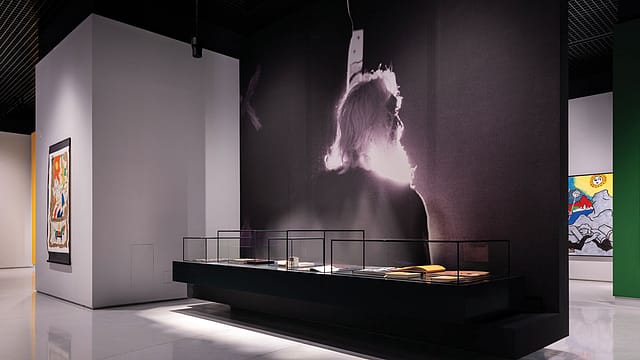
Few artists are ever honoured with their own purpose-built museum but this accolade has been fittingly bestowed on MF Husain, following the artist’s award of Qatari citizenship in 2010. The Qatar Foundation, led by its Chairperson, Sheikha Moza bint Nasser, is the driving force behind the recently-opened Lawh Wa Qalam: MF Husain Museum. It is in Doha’s Education City, nestled among pristine-looking university campuses and the dazzling National Library, in a building which Husain conceived, and was realised by the architect Martand Khosla.
The museum’s three buildings extend over 3,000sq mt, the main galleries covered in blue tiling and calligraphy, with a minaret-like white tower and a separate gallery for the large installation which was to be Husain’s last work, Seeroo Fi al Ardh. Staffed by helpful and knowledgeable guides and filled with large numbers of local and foreign visitors, Lawh Wa Qalam is already an established part of Qatar’s many outstanding galleries and museums.
This arresting collection contains multimedia works of Husain. The upstairs Gallery 1, ‘A world of his own’ has paintings, sculptures, tapestries, photographs and more. It traces Husain’s artistic career from his early life in Maharashtra to his travels around India, displaying film posters to echo his work as a billboard painter.
Husain’s best known films are Gaja Gamini (2000) and Meenaxi: A Tale of Three Cities (2004), which are screened at three levels on the walls in the mesmerising Film Tower. His earlier film, Through the Eyes of a Painter (1967), which won the National Award for Best Experimental Film plays on a loop in the hall along with a Films Division of India film about him.
Husain joined other modernist painters as one of the founding members of the Bombay Progressive Artists’ Group (founded in 1947), and one wall of the museum is covered by a large group photograph, including FN Souza, SH Raza, VS Gaitonde and Husain himself.

Husain lived through the freedom struggle and Independence, marked by his trilogy, India’s One Hundred Years of Struggle for Freedom. I was not familiar with his portraits of Jawaharlal Nehru (1963), CV Raman (1988) and Muhammad Iqbal (1969) which reveal a new dimension of his draughtmanship, painterly technique and psychological insight into his subjects, as different as late is from early Picasso.
The downstairs galleries have more of the work Husain produced during the final decade of his life in Qatar, which show a new productivity and style that develop his later style in profound ways. Gallery 2: ‘A curious mind’ displays paintings on historical and religious themes while Gallery 3, titled ‘An artist without borders’, has works exploring his Yemeni ancestry (Husain was a Suleymani Bohra) and imagining the history of Arab civilisation. There are many of the elements that are so familiar from the earlier work—the equine imagery being the most striking—but there are new elements such as his use of Arabic calligraphy, the appearance of camels and so on.
Husain explores all religions in his paintings, and there are many Indian- Hindu elements such as elephants or the use of swirling colours which are reminiscent of Holi. Yet there are also other themes: moments in Arab history such as the Battle of Badr or Imam Hussain’s horse, Zuljinah.
The Last Supper of the Desert in Red (2008) is one of the museum’s most memorable paintings, showing four people, one of them Christ-like, with a camel looking in and cherubs and putti playing under the table, which is simultaneously amusing and profound.
The Suleymani Bohras are prominent in Yemen and Husain’s trip to the country, which he had yearned to visit for decades, was of great importance to him. The painting Yemen (2008), is vibrant and joyful showing a muezzin by a minaret and a host of other characters, who then reappear in a marvellous multimedia room where several other paintings in the collection come to life on the walls, floor and ceiling with projection mapping and digital animation, along with sound effects taking us through a day from night through dawn to evening in Yemen.
The last gallery, in a separate building, has the installation Seeroo Fi al Ardh (apparently this refers to Quran 29.20: “Travel through the earth and observe how He began creation”). This 20-minute show of humans on land, sea and sky, deploying life-size glass horses and an array of beautifully maintained vintage cars, on a great revolving carousel, in a totally stunning display.
Visiting Lawh Wa Qalam is essential to understanding the life and work of MF Husain as it shows his deep reflections about the world and life, and how religions help us to navigate our existence on earth. A mixture of reverence and irreverence are his signatures, just as his familiar bright primary colours stand against a more muted palate of desert brown.
Husain’s late works make plain how he found a home in Arabic culture that was not strange to him. Even Yemen, which he visited only in old age, felt familiar to him. Yet Husain was shaped by Indian and Hindu culture; born in one of the most important pilgrimage sites, Pandharpur, he understood the aesthetics of dance, music and art of these traditions. The power of the image as an icon is something he might have learnt from these traditions.
HUSAIN RESPECTED other religions while always remaining within his own. He could appreciate other traditions, such as the sanctity of saints in Roman Catholicism, and once said that, having lost his mother at an early age, Mother Teresa represented the figure of a mother to him. He painted her without a face, having forgotten that of his own mother.
I knew Husain a little, having met him during the shooting of Dil To Pagal Hai (1997) when Madhuri Dixit was his great muse. I always found him unlike anyone elseI knew. He had a striking appearance with his white hair and beard, his slender frame and his bare feet, designer clothes, carrying his long paintbrush (some of his personal items are in the upstairs gallery). A simple man with a love of expensive cars, a nomad with a close-knit family, he was serious and intelligent, yet with a childlike sense of the absurd (I was always amused by his emptying his pockets like a magician in a show). There was always something otherworldly about him.
Sometimes it felt as if Husain’s work was too identifiable, omnipresent in public buildings and people’s houses, and he was regarded by some as Picasso was—a commercial artist. No one who visits Lawh Wa Qalam, a unique place with its own magical air, and studies his work will feel this about him again. My only regret is there is no catalogue (so my apologies for any errors in my recollections) to accompany this fascinating collection.
Qatar is not just the hub of an excellent airline. It is also home to the works of the world’s leading architects (including IM Pei, Zaha Hadid, Jean Nouvel) and outstanding museum collections. This time, I visited Rem Koolhaas’ National Library of Qatar, a breathtaking space, welcoming people to come in and engage with the collections rather than to be reverent and silent. Lawh Wa Qalam is yet another reason to visit.